 Ask Athena
Advancement & reputation
Advancing the field of Calibre. Earning reputation through evidence.
IOWL's advancement agenda is to establish Calibre as a serious third dimension of human development alongside Capability and Competency. Its reputation must follow from the quality of the frameworks, the integrity of the standards, the credibility of the evidence and the value created for learners, institutions and society.
Our advancement agenda How reputation is earned
Evidence before claim
Standards before scale
Partnership without dilution
Impact over image
Advance the idea
Make Calibre understandable, developable, assessable and relevant across education, work, institutions and public life.
Protect the standard
Ensure recognition never outruns the learning, assessment and evidence capable of supporting the claim.
Earn the reputation
Let reputation emerge from credible practice, transparent boundaries, trusted partnerships and demonstrable contribution.
Advancement and reputation are related, but they are not the same thing
Advancement is what IOWL deliberately does to move the Calibre proposition forward. Reputation is what others should reasonably conclude from the quality and integrity of that work.
The Institute can choose to invest in research, improve frameworks, widen access, build partnerships, strengthen assessment and contribute to public debate. It cannot credibly declare its own reputation into existence.
For that reason, the current IOWL approach is deliberately evidence-led: develop the field, create useful and defensible recognition, govern it carefully, test it in real contexts and allow reputation to grow from the resulting record.
The distinction
Advancement: what we deliberately improve, develop, contribute, test and extend.
Reputation: the confidence others place in IOWL because of what we consistently demonstrate.
The second should be a consequence of the first.
The IOWL advancement agenda
The objective is not simply to make IOWL better known. It is to make the Calibre proposition more useful, more credible and more capable of producing positive outcomes at increasing scale.
1
Advance Calibre as the third dimension
Strengthen understanding of the relationship between Capability, Competency and Calibre, and why employability, leadership and performance are stronger when all three are developed in balance.
2
Advance Positive Value Leadership™
Continue developing the relationship between Positive Values, transformation, internalisation, Calibre and Integrous Agency so that PVL remains a living developmental framework rather than a static model.
3
Advance credible recognition
Strengthen the learning, assessment and assurance architecture behind Calibre Credits™, professional standing and the Passport of Probity™ so recognition remains proportionate to evidence.
4
Advance access
Use no-fee Aspirant Access, Cornerstone and institutional deployment to place the Calibre-development infrastructure within reach of students, workers and citizens who may need it later in life.
5
Advance evidence and application
Build stronger evidence around how Calibre affects employability, trusted performance, workforce reliability, leadership behaviour and the conversion of Capability and Competency into outcomes.
6
Advance through collaboration
Work with universities, employers, governments and international bodies where collaboration can improve contextual understanding, access, application and external challenge without weakening IOWL's standards.
How institutional reputation is earned
Reputation should rest on a set of behaviours and disciplines that others can observe, test and challenge.
Clarity of purpose
IOWL should be consistently clear that it specialises in Calibre and complements, rather than replaces, academic Capability and practical Competency.
Integrity of claims
Public claims should remain within what the evidence and institutional role can support, avoiding inflated language about accreditation, superiority, causation or guaranteed character.
Quality of recognition
Professional standing and Calibre Credits should be backed by transparent developmental purpose, appropriate assessment and clear separation between learning and awarding functions.
Governance and independence
Decision-making, advisory participation and awarding responsibilities should be clear enough that partners, learners and observers can understand where accountability sits.
Partnership behaviour
Credible partners should experience IOWL as rigorous, reciprocal and dependable, with commitments, roles, evidence and boundaries understood on both sides.
Evidence of contribution
Reputation becomes stronger when learners, institutions and systems can point to useful outcomes, better decisions, stronger development or improved performance rather than promotional language alone.
The Calibre Development Triad™ protects advancement from becoming superficial
ICF, CCF and PCD give IOWL a coherent developmental architecture through which the Calibre proposition can deepen over time without losing alignment between substance, learning and lifelong application.
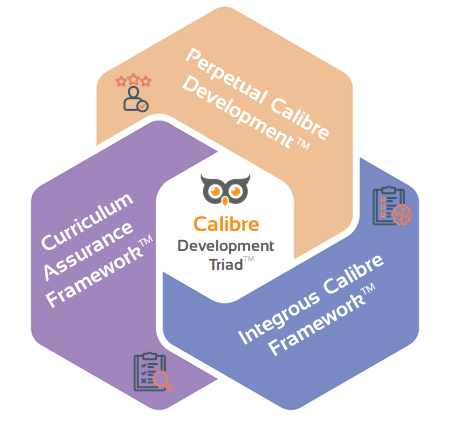
Three complementary mechanisms
- Integrous Leadership Calibre Framework™ (ICF): provides the interdisciplinary foundation that informs what meaningful Calibre development should address.
- Curriculum and Calibre Assurance Framework™ (CCF): protects the alignment between purpose, curriculum, learning, assessment and recognition.
- Perpetual Calibre Development™ (PCD): keeps Calibre development continuous, need-led and contextually driven across life and changing responsibility.
Recognition is one of the most visible tests of reputation
Every award creates an institutional claim. The strength of IOWL's reputation therefore depends in part on whether those claims remain disciplined and defensible.
Aspirant Access, Cornerstone, Basal and Bedrock deliberately make limited developmental claims. Foundation, Keystone and Capstone carry stronger professional recognition because they add the relevant learning and assessment evidence.
Evidence before recognition
On eligible professional pathways, the recognition architecture combines:
Structured PVL development
Positive Values, judgement, reflection, responsibility, transformation and Integrous Agency provide the developmental foundation.
Knowledge assessment
Confirms understanding of the relevant PVL principles, exemplars and frameworks.
Structured reflective assessment
Examines the quality and authenticity of reasoning, insight and application rather than using a personality classification.
Independent awarding function
The Global Institute for Calibre & Integrity™ is the specialist awarding authority for Calibre Credits™ and connected professional recognition.
Calibre Credits™ are deliberately distinct
On eligible assessed professional pathways, successful candidates can receive between 31 and 50 Calibre Credits™. They are not university academic credits, generic CPD points, attendance points or a personality score. Their credibility depends on preserving that distinction rather than borrowing the status of another recognition system.
Institutional architecture behind the reputation
Different parts of IOWL have different responsibilities. This separation makes the institution easier to scrutinise and helps protect against conflicts between development, assurance, awarding and promotion.
Centre for Positive Value Leadership™
Develops and stewards the PVL framework through which Positive Values are translated into transformation, Calibre and Integrous Agency.
Explore PVL >Global Institute for Calibre & Integrity™
Provides the specialist standards and awarding function for Calibre Credits™, professional standing and connected recognition records.
Explore GICI >Centre for Calibre-Driven Productivity & Performance™
Extends the Calibre proposition into employability, workforce reliability, organisational performance and policy or system outcomes.
Explore CDPP >Governance & assurance
Executive accountability, international advisory input and assurance mechanisms provide challenge while keeping institutional roles and recognition responsibilities explicit.
Understand governance >Partnership can strengthen reputation, but only when it strengthens substance
A logo, meeting or memorandum is not evidence of impact. IOWL's partnership reputation should be built through reciprocal engagement, operational follow-through and outcomes that matter to both parties.
Universities are a particularly important example
IOWL should not ask a university to abandon or duplicate its strengths. Universities remain specialists in Capability and contribute substantially to Competency. IOWL brings the specialist Calibre-development and recognition architecture. A credible partnership therefore creates complementarity rather than competition.
The reputational value comes from doing this well: clear roles, suitable learner populations, responsible onboarding, useful evidence, honest evaluation and a willingness to improve the model where experience shows it should change.
Explore university partnerships > Explore wider partnerships >
Reputation guardrails
The easiest way to damage an emerging field is to make claims faster than the evidence can support them. These boundaries are therefore part of the advancement strategy, not restrictions on it.
Do not confuse professional recognition with academic accreditation
IOWL's professional Calibre recognition is distinct from university academic credit and external academic accreditation systems.
Do not claim superiority over external quality systems
IOWL's CCF serves a different purpose. It complements external academic or professional quality assurance rather than claiming to replace or exceed it.
Do not turn partnership into implied endorsement
Collaboration with an individual or institution should be described accurately. Advisory participation, meetings or joint work do not automatically imply accreditation, sponsorship or institutional endorsement.
Do not overstate what a Calibre award proves
Professional standing records that defined learning and assessment standards were met. It does not guarantee future behaviour or certify moral perfection.
Do not claim Calibre is the sole cause of performance
Productivity and organisational performance are multi-causal. CDPP examines how Calibre can influence conversion, trust and reliability without pretending other economic, technical or institutional factors do not matter.
Do not trade standards for scale
Growth only advances reputation when delivery, learner experience, assessment integrity and partner obligations remain strong enough to support the larger footprint.
Continuous improvement is part of institutional reputation
Frameworks should be stable enough to mean something, but not so static that evidence and experience cannot improve them.
IOWL's advancement requires disciplined learning from delivery: learner engagement, assessment performance, partner experience, operational failures, stakeholder challenge and applied evidence all provide information that can improve the architecture.
The objective is not constant reinvention. It is controlled evolution: preserve the Positive Values and the core Calibre proposition, while improving how they are taught, contextualised, assessed, evidenced and applied.
Advance by learning
Foresight: anticipate risks before deployment.
Insight: monitor what is happening during delivery.
Hindsight: use evidence afterwards to improve the next iteration.
The same developmental discipline expected through PCD should inform institutional learning.
Frequently asked questions
Key points about what IOWL means by advancement, how reputation should be built and why institutional restraint is part of credibility.
Advancement means deliberately improving and extending the Calibre proposition: its conceptual clarity, developmental frameworks, accessibility, assessment, recognition, evidence base, partnerships and real-world application.
Reputation is the confidence others place in IOWL because of what the Institute consistently demonstrates. It should arise from evidence, standards, behaviour, outcomes and relationships rather than promotional claims alone.
Because CCF and external academic quality systems serve different purposes. IOWL's assurance framework protects the alignment of Calibre development, curriculum, assessment and recognition. Credibility is stronger when that role is explained precisely rather than through unsupported superiority claims.
They create a visible recognition claim. Their reputational value therefore depends on the integrity of the learning, assessment, assurance and awarding processes behind them. The Global Institute for Calibre & Integrity™ is the sole awarding authority for Calibre Credits™.
No, unless a separate formal arrangement explicitly says so. Partnership can involve student access, pilots, research, dialogue or deployment without implying academic accreditation or transfer of IOWL's Calibre-awarding authority.
Governance makes accountability and institutional boundaries visible. Clear executive responsibility, advisory roles, assurance functions and awarding authority reduce ambiguity and make the institution easier to scrutinise.
Only if standards, learner experience, partner obligations, operations and assessment integrity scale with the reach. Growth that weakens those foundations would undermine rather than advance reputation.
Build substance
Advance the frameworks, evidence and application before focusing on how widely the Institute is known.
Protect credibility
Keep institutional claims, recognition and partnerships within boundaries that can be clearly explained and defended.
Let reputation follow
Trust becomes more durable when it emerges from repeated evidence of quality, integrity, reliability and useful contribution.
Advance Calibre by strengthening what sits behind the claim
Explore IOWL's purpose, understand the Calibre-development and recognition architecture, or discuss how an institutional partnership can contribute to credible development and wider impact.
About IOWL Assurance architecture Partner with IOWL