 Ask Athena
Accreditation, assurance & professional recognition
Credibility depends on saying exactly what the evidence supports
IOWL separates the development of Calibre from the assurance and recognition of that development. The Calibre Development Triad™ explains how Calibre is cultivated; the assurance and recognition architecture explains how curriculum, assessment and awards are kept credible.
Explore the Calibre Development Triad Understand Calibre Credits
Calibre Development Triad™
Curriculum assurance
Assessment integrity
Professional recognition
Academic assurance
Universities and authorised education bodies retain responsibility for their own academic standards, awards and regulatory obligations.
IOWL assurance
IOWL assures the design, delivery, assessment and recognition claims of its own Calibre-development pathways.
Professional recognition
The Global Institute for Calibre & Integrity™ awards Calibre Credits and connected professional standing on eligible assessed pathways.
Accreditation, assurance and recognition are not the same thing
The distinction matters. IOWL should not blur academic accreditation, internal assurance and professional recognition into a single claim.
External context
Academic or regulated accreditation
Where a university, regulator, professional body or authorised accreditor applies its own standards, that accreditation remains governed by that body and its jurisdiction. IOWL does not replace those arrangements.
Internal assurance
IOWL curriculum and assessment assurance
IOWL uses its own assurance architecture to keep course purpose, curriculum, learner experience, assessment and recognition aligned with the Calibre claim being made.
IOWL recognition
Professional Calibre recognition
On eligible assessed pathways, successful candidates may receive Calibre Credits™, professional standing and a Passport of Probity™ through the Global Institute for Calibre & Integrity™.
The Calibre Development Triad™ (CDT)
Before Calibre can be assessed or recognised, it has to be deliberately developed. IOWL brings three complementary mechanisms together so that development is grounded, structured and continuous.
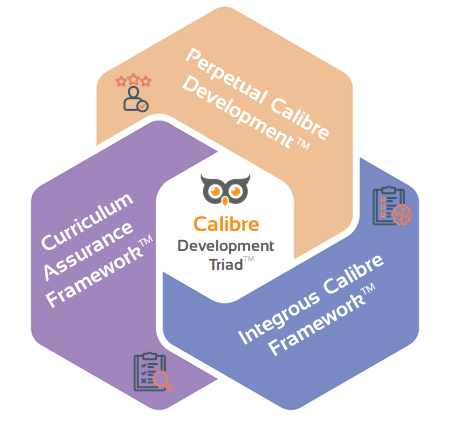
Three mechanisms, one developmental architecture
The Triad separates three questions that are easy to blur: what informs the development of Calibre, how that development is designed into learning, and how it continues throughout life.
The Integrous Calibre Framework™ provides the developmental foundation. The Curriculum and Calibre Assurance Framework™ turns that foundation into coherent learning and protects the relationship between curriculum, assessment and recognition. Perpetual Calibre Development™ ensures that Calibre is treated as continuing, need-led and contextually driven rather than completed by one course.
The key distinction: the Triad develops Calibre. The assurance and recognition architecture protects the credibility of how that development is assessed, evidenced and recognised.
Developmental foundation
Integrous Calibre Framework™ (ICF)
The ICF provides the foundation for what IOWL seeks to develop when it speaks about Calibre: Positive Values, judgement, integrity, responsibility, behavioural reliability, consequence-awareness and the qualities expected of Positive Value Leadership.
It draws the Calibre question beyond knowledge and skill alone and keeps the focus on how a person exercises what they know and can do when choices, pressure, influence and consequences are involved.
Curriculum and assurance
Curriculum and Calibre Assurance Framework™ (CCF)
The CCF governs how the intended Calibre development is translated into pathway purpose, curriculum sequence, learning activity, reflection, assessment and recognition.
Its central discipline is that the strength of the recognition claim must remain proportionate to the strength of the evidence the learner has actually produced.
Lifelong development
Perpetual Calibre Development™ (PCD)
PCD provides the lifelong continuum. Development is continuous, but need-led and contextually driven: people revisit judgement, values, behaviour and responsibility as their roles, circumstances and influence change.
A course or award can therefore represent a meaningful milestone without implying that Calibre development has been permanently completed.
From development to credible recognition
The Triad explains the development side of the system. A second layer then governs what can be claimed and awarded from that development.
1. CCF assuranceChecks that purpose, curriculum, learning experience, assessment and recognition remain aligned.
2. Assessment integrityRequires evidence appropriate to the strength of the Calibre claim being made.
3. GICI awardingThe Global Institute for Calibre & Integrity™ awards Calibre Credits and professional recognition where the required standard is met.
4. Continuing PCDRecognition becomes an assessed milestone within a continuing developmental journey.
The Calibre assurance and recognition architecture
Once development has taken place, credibility depends on a separate chain of assurance, assessment and awarding. No single framework should be expected to perform every function.
Design assurance
Curriculum and Calibre Assurance Framework™
The CCF aligns pathway purpose, curriculum, Calibre development, assessment and recognition. Its core principle is that recognition must never outrun evidence.
Understand the CCF >
Assessment integrity
Evidence appropriate to the claim
Introductory awareness, aspiration and intent are distinguished from professionally assessed Calibre. Stronger recognition requires stronger evidence.
Explore pathway requirements >
Awarding standards
Global Institute for Calibre & Integrity™
The Global Institute is the specialist standards and awarding institute for Calibre Credits™ and the connected professional recognition architecture.
Understand GICI >
Continuing development
Perpetual Calibre Development™
Recognition is a milestone within lifelong, need-led Calibre development. An award should never imply that personal development has been permanently completed.
Understand PCD >How assessed Calibre recognition is earned
On eligible professional pathways, formal recognition depends on more than attendance or content completion. The learning and assessment architecture distinguishes understanding from reflective application.
1
Structured engagement
The learner completes the required Positive Value Leadership learning journey and the engagement conditions needed to become eligible for assessment.
2
Knowledge assessment
A knowledge component confirms understanding of the principles, exemplars and frameworks that underpin the relevant Positive Value Leadership pathway.
3
Reflective assessment
A structured reflective component examines the authenticity, depth and quality of reasoning, personal insight and application. It is not a personality test.
4
Recognition outcome
Where the required components are passed, the Global Institute may award the applicable Calibre Credits and connected professional recognition records.
Both assessed components must meet the required standard. Calibre Credits™ are not awarded where the required knowledge or reflective assessment standard is not met. Successful candidates on an eligible pathway may receive between 31 and 50 Calibre Credits™, subject to the applicable assessment outcome and IOWL rules.
Public assurance does not require disclosure of protected mechanics. IOWL publishes the standards, candidate-facing requirements, governance, evidence position and meaning of recognition needed for informed scrutiny. Detailed assessment engineering, calibration, weighting, decision, integrity and anti-gaming mechanisms remain protected IOWL know-how and are not publicly disclosed.
Recognition grows with the strength of the evidence
Every pathway should be understood according to what it is designed to evidence. Introductory recognition is deliberately different from professional Calibre recognition.
| Stage | Pathway | What it recognises | Calibre Credits? | Recognition boundary |
|---|---|---|---|---|
| Aspirant Access | STM001 | Access to the Aspirant Stratum and introductory IOWL resources. | No | Access and orientation only. It is not an assessed Calibre award. |
| Awareness | Cornerstone - CAD001 | Statement of Calibre Awareness and Development Intent™. | No | Confirms introductory understanding and development intent; it does not certify a level of personal Calibre. |
| Aspiration | Basal - BPC100 | Statement of Aspiration, Calibre and Integrity. | No | Records aspiration within the IOWL journey without claiming professionally assessed Calibre. |
| Intent | Bedrock - BAC200 | Statement of Intent, Calibre and Integrity. | No | Records stronger intent and readiness for later professional recognition. |
| Professional recognition | Foundation - FAC300 | Certified Associate professional standing and connected recognition records. | Yes | First assessed professional pathway on which formal Calibre Credits are available. |
| Professional recognition | Keystone - KMC400 | Certified Member professional standing and connected recognition records. | Yes | Assessed professional recognition for managers, professionals and developing leaders. |
| Advanced professional recognition | Capstone - CFC500 | Certified Fellow professional standing and connected recognition records. | Yes | Advanced assessed recognition for experienced and senior professionals and leaders. |
What formal professional recognition looks like
On eligible assessed pathways, Calibre recognition is presented through a connected set of records rather than a single certificate or score.
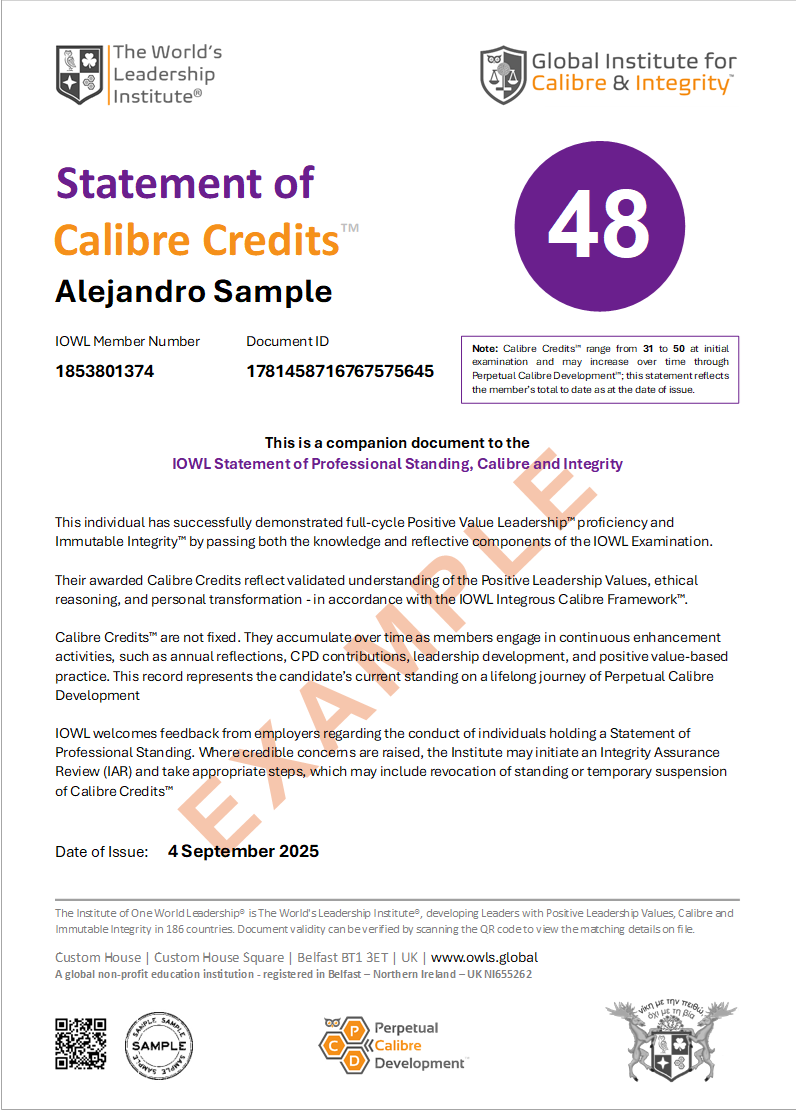
Statement of Calibre Credits™
Records the Calibre Credits awarded through the Global Institute for Calibre & Integrity™ where the relevant professional assessment requirements have been passed.

Statement of Professional Standing
Confirms the learner's certified IOWL status, such as Certified Associate, Certified Member or Certified Fellow, and the professional standing associated with that pathway.

Passport of Probity™
Provides a portable, verifiable record of IOWL standing that brings together the learner's professional recognition, status and continuing Calibre record.
For universities: complementarity, not competition
IOWL's assurance proposition should strengthen a university partnership, not imply that IOWL is replacing the university's academic role.
A clear division of expertise
University: academic Capability, disciplinary knowledge, qualifications, institutional quality assurance and the Competency developed through practical learning and employability provision.
IOWL: specialist Calibre development, the assurance of IOWL curriculum and assessment, and professional Calibre recognition through the Global Institute for Calibre & Integrity™.
The result is the three-legged employability proposition: Capability + Competency + Calibre, with each institution concentrating on the dimension it is best placed to develop and assure.
What the assurance architecture protects against
Credibility depends on controlling overstatement as carefully as controlling under-performance.
Confusing professional recognition with academic accreditation
IOWL professional standing and Calibre Credits are distinct from university academic credit, degree accreditation or statutory qualification approval.
Recognition inflation
A short awareness experience must not be described as if it proves the same thing as a professionally assessed Calibre pathway.
Assessment mismatch
Knowledge recall alone should not be presented as evidence of the same outcome as a pathway requiring structured reflective assessment and professional recognition standards.
Claims of moral perfection
Calibre recognition does not claim that an individual can never make a poor decision. It evidences that the applicable learning and assessment standard was met at the point of award.
Frequently asked questions
Key points about IOWL assurance, professional recognition, Calibre Credits and the relationship with academic accreditation.
This page does not present IOWL as a statutory academic accreditor. Academic accreditation and regulated qualification approval remain matters for the relevant authorised bodies and institutions. IOWL's specialist role is Calibre development, internal assurance of its own pathways and professional Calibre recognition.
The Calibre Development Triad™ brings together the Integrous Calibre Framework™, the Curriculum and Calibre Assurance Framework™ and Perpetual Calibre Development™. Together they explain the developmental foundation, the curriculum and assurance mechanism, and the continuing lifelong process through which IOWL approaches Calibre development.
IOWL assures the alignment of its course purpose, curriculum, Calibre-development intent, learner experience, assessment model and recognition claims. The Curriculum and Calibre Assurance Framework™ provides the core design and recognition-assurance architecture.
Calibre Credits™ were created by IOWL and are awarded through the Global Institute for Calibre & Integrity™, which is the sole awarding authority for them.
No. They are a distinct IOWL professional recognition currency for assessed Calibre. They complement rather than replace academic credit, professional qualifications, skills evidence or CPD records.
Calibre Credits are reserved for eligible assessed professional pathways: Foundation, Keystone and Capstone. Aspirant Access, Cornerstone, Basal and Bedrock have different purposes and do not award Calibre Credits.
Cornerstone is deliberately an awareness and development-intent pathway. Successful learners receive a Statement of Calibre Awareness and Development Intent™. The recognition reflects introductory understanding and declared intent; it does not claim the stronger evidence required for professionally assessed Calibre.
The university retains responsibility for its academic provision and institutional QA. IOWL applies its own assurance framework to the IOWL Calibre-development and professional-recognition components that complement the university's Capability and Competency provision.
No. Perpetual Calibre Development™ treats Calibre as lifelong, need-led and contextually driven. Formal recognition is an assessed milestone within that continuing journey.
Assure
Keep the purpose, curriculum, assessment and recognition of each pathway aligned.
Assess
Use evidence proportionate to the strength of the Calibre claim being made.
Recognise
Award professional standing and Calibre Credits only where the applicable standard has been achieved.
Explore how IOWL develops, assures and recognises Calibre
The Calibre Development Triad™ explains how Calibre is developed. The CCF protects curriculum and recognition alignment. The Global Institute explains how professionally assessed Calibre is awarded and recognised. PCD ensures that development continues beyond any one award.
Understand the CCF Understand Calibre Credits Understand PCD