 Ask Athena
Government and Public Service | Calibre, Integrity and Public Trust
Public service depends on more than knowing the rules. It depends on the Calibre with which public responsibility is exercised.
Governments invest heavily in policy knowledge, professional capability, operational skills, governance and compliance. IOWL adds a complementary human dimension: structured development and evidence of the judgement, integrity, responsibility, empathy and Positive Values governing how public capability is used.
See the public-service model Explore institutional use Government as national advocatePublic administrationFrontline servicesIntegrity and governanceLeadership and workforce developmentPublic trust
This page is about government and public service as an employer.
For the wider national proposition in which government advocates Calibre across students, apprentices, workers, employers, jobseekers and citizens, see Calibre for Society. That model helps a country strengthen productivity and performance across today's population while developing the workforce of tomorrow.
Explore Calibre for SocietyPublic performance rests on three legs
Public institutions need knowledgeable people, competent people and people who can be depended upon to exercise public responsibility well. The IOWL Leadership Stool™ makes those three dimensions visible.
Capability
What does the person know and understand?
Policy, legislation, professional knowledge, service context and technical understanding.
Competency
What can the person do effectively?
Operational delivery, communication, professional practice, case management, management and service execution.
Calibre
How will they exercise what they know and can do?
Judgement, integrity, responsibility, empathy, consequence-awareness and Positive Values under pressure.
Capability and Competency create public-service capacity. Calibre helps govern the direction in which that capacity is used.
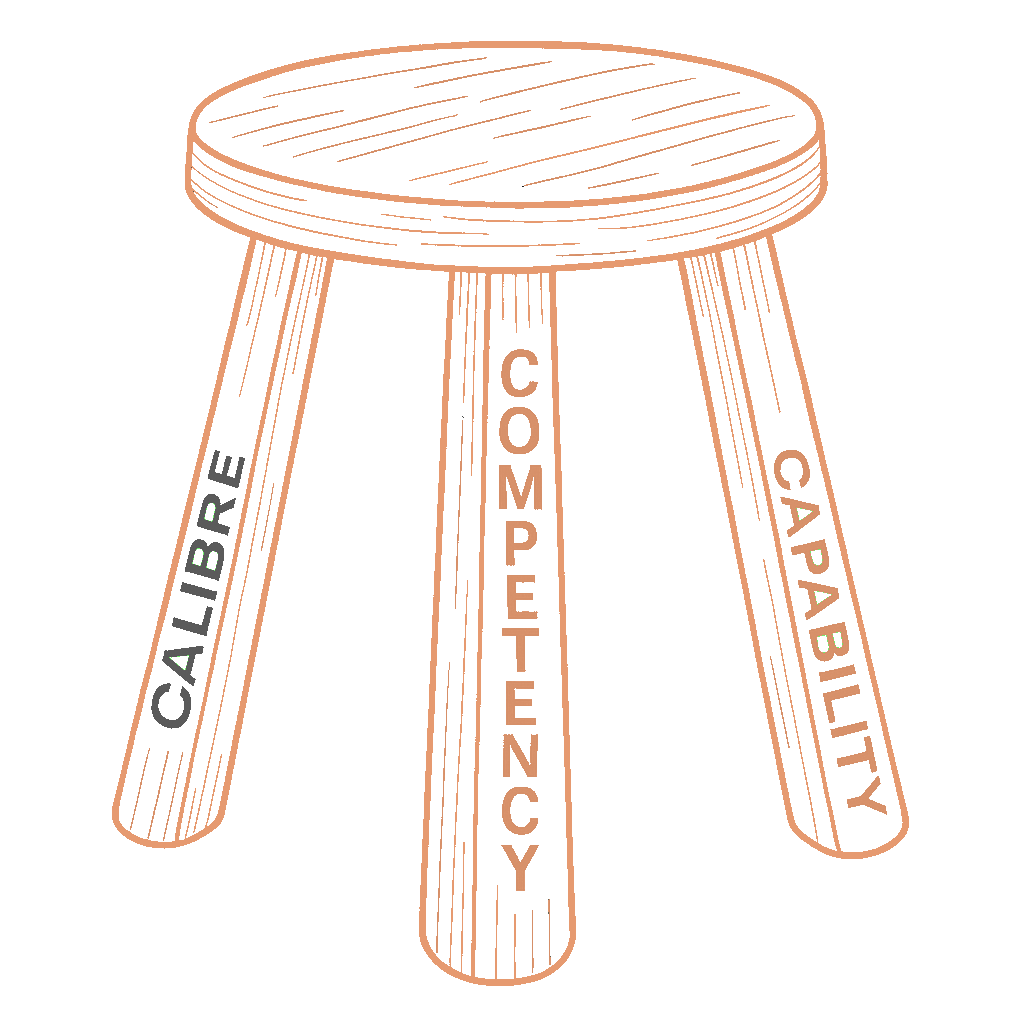
The IOWL Leadership Stool™: Capability + Competency + Calibre.
From public contact to public confidence
Public trust is affected by countless individual decisions and interactions. A benefits decision, safeguarding judgement, regulatory conversation, licence application, inspection, procurement decision, policy explanation or complaint response can strengthen or weaken confidence in the institution behind it.
The public-service opportunity is to combine accurate processing with the consistent, humane, fair and accountable exercise of policy and discretion, especially where citizens may be vulnerable or under pressure.
Service delivery
Accuracy with humanity
Apply policy consistently while explaining decisions clearly, treating people with dignity and recognising the human consequences of administrative action.
Safeguarding
Recognise vulnerability
Use judgement, empathy and consequence-awareness where a routine process intersects with vulnerability, risk or a need for escalation.
Public money
Use resources responsibly
Exercise stewardship over public funds, time, information and organisational resources while remaining alert to waste, bias and conflicting incentives.
Regulation and enforcement
Use authority proportionately
Apply rules and powers consistently while understanding their purpose, the limits of discretion and the consequences of how authority is exercised.
Policy implementation
Turn intent into practice
Recognise that even well-designed policy depends upon thousands of human interpretations and decisions at the point of delivery.
Leadership
Shape the conditions for integrity
Build cultures in which people can challenge, disclose, collaborate, learn and correct emerging problems before poor practice becomes normalised.
Every public interaction can become a conduit between policy and public confidence. Calibre concerns the quality of judgement and conduct governing that connection.
The six Positive Value Exemplars in public service
Positive Value Leadership™ provides a common Positive Values baseline that can be applied across roles, departments, professions and public-service contexts. The six Exemplars give a practical way to examine how responsibility is exercised.
Probity
Use position and authority responsibly. Make fair, unbiased decisions, protect the integrity of information and challenge conduct that may cause harm.
Potency
Use influence constructively. Uplift others, remain resilient under pressure and contribute positively to colleagues, citizens and service outcomes.
Planet
Use human, financial, natural and organisational resources responsibly, efficiently and with regard to wider consequences.
People
Treat people with dignity and respect, remaining mindful of the emotional, mental and physical impact public decisions and interactions can have.
Perception
Encourage the exchange of information, explain decisions clearly and avoid withholding or using information in ways that create inequitable advantage.
Participation
Build collaborative relationships, support colleagues, make responsible handovers and contribute openly rather than allowing organisational boundaries to obstruct service.
The Axiological Pyramid: public integrity from the inside out
Public institutions require strong professional standards, governance and compliance. The IOWL Calibre architecture complements them by asking what sits beneath those controls and how the layers align when an individual has to make a real decision.
Values are personally held and internal. Morals are socially influenced. Organisational Values establish contextual commitments. Ethics provides professionally determined expectations. Governance provides internal organisational control. Compliance reflects external laws, regulation and requirements.
The upper strata are necessary. The question is how dependent they must become on supervision, control, sanction and enforcement when the human foundation below is weak, conflicted or misaligned.
Trust emerges from alignment across the pyramid.
Trust is what can emerge when the layers are aligned and conduct repeatedly proves worthy of it. Sustainable trustworthiness is built from the inside out, while regulation and control necessarily work from the outside in.
ComplianceExternal requirements, law and regulation
GovernanceInternal organisational control
EthicsProfessionally determined expectations
Organisational ValuesContextual commitments
MoralsSocially influenced understanding
ValuesPersonal, internal and increasingly examined
InternalContextualProfessionalInstitutionalExternal
The aim is earlier, stronger internal judgement. Governance and rules then operate as reinforcement rather than late-stage compensation for weakness beneath them.
Recruit, appoint and develop for Calibre
Public-sector recruitment already examines qualifications, experience, competencies and role-specific requirements. IOWL adds a practical question: what evidence is available about the Calibre with which public responsibility will be exercised?
Specify
Ask
Verify
Appoint
Develop
Recognise
Continue PCD
Person specification
Where appropriate, include recognised Calibre evidence as a preferred additional criterion for roles carrying significant trust, discretion, authority, safeguarding, public contact or leadership responsibility.
Suggested wording:
Recognised evidence of structured Calibre development, including current IOWL professional standing or Calibre Credits™, is desirable. Where the recognition is still to be developed, the successful candidate can complete an appropriate IOWL Positive Value Leadership™ pathway as part of agreed professional development.
Recognised evidence of structured Calibre development, including current IOWL professional standing or Calibre Credits™, is desirable. Where the recognition is still to be developed, the successful candidate can complete an appropriate IOWL Positive Value Leadership™ pathway as part of agreed professional development.
Application and interview
Ask directly whether the candidate holds IOWL Calibre recognition and explore what the development caused them to examine differently about judgement, responsibility, empathy, challenge and consequence.
Suggested question:
What current IOWL Calibre recognition do you hold, and what have you learned from the development and assessment behind it?
What current IOWL Calibre recognition do you hold, and what have you learned from the development and assessment behind it?
Appointment and development opportunity
Strong candidates can enter from different starting points, with IOWL recognition providing an additional development and evidence route. Where employer policy supports it, the relevant PVL pathway can form part of onboarding, probation, first-year development or preparation for increased responsibility.
Promotion and public responsibility
As discretion, influence and consequence increase, Calibre development can deepen alongside Capability and Competency, strengthening the person for greater responsibility.
Specialist professional routes within public service
The public-service proposition connects directly with two specialist professional contexts: how people are recruited and developed, and how integrity, risk, governance and compliance are exercised in practice.
For public-sector HR and recruitment professionals
See how Calibre can be built into person specifications, applications, interviews, appointment, onboarding, promotion and continuing development alongside existing capability and competency requirements.
For compliance, risk, governance and integrity professionals
See how the Axiological Pyramid, Calibre evidence and PCD can complement rules, controls, assurance, investigations, escalation and higher-trust roles.
What Calibre evidence should public-sector HR look for?
For roles carrying significant public responsibility, the strongest IOWL evidence is normally the professionally assessed recognition associated with Foundation, Keystone or Capstone. Earlier IOWL documents demonstrate development intent, while awarded Calibre Credits and recognised professional standing provide the stronger professionally assessed evidence layer.
Professionally assessed recognition
Statement of Professional Standing
Confirms the holder's recognised professional standing following successful completion of the applicable assessed PVL pathway and relevant IOWL requirements.
Public-service use: additional evidence for recruitment, promotion and roles carrying material responsibility, authority or influence.
Awarded Calibre evidence
Statement of Calibre Credits™
Records Calibre Credits™ awarded following successful completion of the applicable learning and formal assessment requirements. Eligible assessed professional pathways can award 31 to 50 Calibre Credits™.
The credit total records assessed Calibre development within the IOWL recognition architecture and is distinct from academic credit or CPD attendance points.
Public-service use: structured evidence of assessed Calibre development to consider alongside Capability, Competency and existing professional requirements.
Combined portable record
Passport of Probity™
Brings together the holder's professional standing and Calibre evidence and supports continuing Perpetual Calibre Development™.
Public-service use: a consolidated recognition and discussion record across recruitment, development and progression.
Calibre evidence adds a specialist human-dimension evidence layer to public-sector recruitment and assurance. It sits alongside qualifications, competency assessment, references, vetting, licences, statutory requirements, security clearance and other role-specific due diligence.
See the full employer guide to Calibre evidence and documents >
Where government and public-service organisations can embed Calibre
Calibre provides a common development and recognition layer across the points where public capability, professional judgement, institutional integrity and citizen experience meet.
People and workforce
Recruitment, onboarding and progression
Ask for Calibre evidence, create development routes for new appointees, and match further PVL development to increasing responsibility.
Service delivery
Frontline consistency and empathy
Develop the judgement, fairness, humanity and consequence-awareness required when policy meets real people and difficult circumstances.
Integrity
Anti-corruption and responsible agency
Strengthen the human judgement beneath codes, controls, disclosure obligations, procurement rules, conflicts of interest and public accountability.
Governance and assurance
Inside-out and outside-in alignment
Use governance and compliance as necessary control systems while strengthening the values-led judgement of the people operating within them.
Leadership
Responsibility before authority expands
Develop Calibre as employees move into management, senior leadership, policy influence, public representation or materially greater discretion.
Policy implementation
Protect intent at the point of delivery
Recognise that implementation quality depends on both policy design and the judgement of those interpreting and applying it.
Public trust
Build trustworthiness through conduct
Focus on the repeated behaviours through which citizens experience fairness, openness, competence, humanity and responsibility in practice.
Productivity and performance
Improve the conversion of capacity into performance
Examine whether judgement, information sharing, responsibility, collaboration and integrity affect how public-sector capability converts into realised performance.
IOWL canonical productivity relationship: ((Health + Education + Knowledge) × (Capability + Competency)) × Calibre = Productivity. This is the policy contention used in IOWL's UK Parliament and Irish Government submissions; evaluation tests the pathway through realised performance and productivity.
Match development to responsibility
IOWL's assessed professional pathways move from the individual, through organisational responsibility, to wider societal and systems influence.
Foundation
Self and professional foundation.
Suitable for entry and early-career professional responsibility where a structured Calibre foundation is required.
Keystone
Organisation and influence.
Suitable where employees supervise, interpret policy, influence colleagues or make decisions with wider organisational consequences.
Capstone
Society and wider systems.
Suitable where decisions affect culture, governance, public trust, institutional direction or broader societal outcomes.
Strengthen existing public-service frameworks with a specialist Calibre layer
IOWL provides the specialist Calibre layer alongside the policy, technical training, professional standards, governance, operational procedures and statutory compliance already owned by departments and public bodies.
Existing frameworks
Define the capability, competency, behaviours, professional standards, public-service values and regulatory requirements appropriate to the jurisdiction and role.
IOWL Calibre architecture
Develops and assesses the Positive Values, reflection, judgement, responsibility and values-led agency governing how that capability and competency are exercised.
Together
Capability + Competency + Calibre provide a fuller foundation for dependable public performance than any one dimension can provide alone.
For UK public-service settings, IOWL can be aligned alongside frameworks such as the Civil Service Code and Success Profiles. In other jurisdictions, the same complementary approach can be applied alongside the relevant public-service codes, professional standards and administrative frameworks.
Evaluate the public-service proposition with clear evidence discipline
A strong evaluation approach defines the intended Calibre contribution, establishes a baseline and measures relevant indicators over time.
Potential indicators for an agreed public-service evaluation
Depending on the service context, an organisation might choose to examine:
- decision quality and consistency;
- repeat contact, rework or avoidable escalation;
- complaints and complaint themes;
- safeguarding or vulnerability-handling consistency;
- information sharing and quality of handovers;
- employee confidence in challenge, disclosure and escalation;
- staff engagement, retention or wellbeing indicators;
- citizen or service-user experience;
- selected productivity and performance measures;
- learner reflection, assessed Calibre evidence and continuing PCD participation.
The purpose is to build a strong evidence base. Baseline, end-point and follow-up evidence can show how Calibre development connects with wider organisational outcomes, with independent evaluation of the reported effects and outcomes adding further strength where appropriate.
Review IOWL's Emerging Evidence discipline > | Explore Calibre-Driven Productivity & Performance >
From hindsight to foresight in public administration
Public-sector reviews frequently begin after something has gone wrong. IOWL uses hindsight as the starting point for a more preventative question: what judgement, assumptions, incentives, pressures or values conflicts were developing before the failure became visible?
Hindsight
What happened and why?
Look beneath the visible incident or breached control to understand the human and organisational conditions that produced it.
Insight
What is happening now?
Recognise current pressures, information gaps, competing interests, incentives and the individual's own contribution to the situation.
Foresight
What is likely to happen next?
Anticipate consequence and respond responsibly before the situation becomes an ethical, governance or compliance failure.
The objective is preventative judgement. Develop the capacity to recognise and address risk before integrity failure becomes visible.
Frequently asked questions
Practical questions for government departments, public bodies, civil-service leaders and public-sector workforce teams.
Public bodies retain their existing capability, competency, professional and behavioural frameworks. IOWL adds the specialist Calibre dimension: the Positive Values, judgement, responsibility and values-led agency governing how capability and competency are exercised.
These are necessary upper strata within the wider architecture of trustworthiness. PVL works lower in the Axiological Pyramid by developing the human foundation beneath them. The proposition is alignment between inside-out judgement and outside-in systems of control.
Yes. The 2025 IOWL public-service work for the Northern Ireland Department for Communities and UK welfare-service context was designed to complement the Civil Service Code and Success Profiles rather than replace them. The same principle can be applied to relevant codes and professional frameworks in other jurisdictions.
Requirements should be proportionate to the role, jurisdiction and employment context. IOWL recommends considering assessed Calibre evidence as a preferred additional criterion where judgement, discretion, trust, safeguarding, leadership or public consequence are material, with a clear development route for strong candidates who can add the evidence through further development.
Calibre Credits provide assessed evidence of demonstrated Calibre development at the applicable stage of recognition. They add warranted confidence alongside vetting, professional accountability, management, governance and other public-sector assurance processes. PCD then extends and recalibrates the evidence as responsibility, context and conduct develop over time. Review the Basis of Calibre >
Yes. The public-service proposition applies wherever judgement and responsibility are exercised. The appropriate pathway and implementation model should match the participant's role, influence, discretion and context so Calibre development can be matched across frontline, professional, managerial and senior leadership roles.
Perpetual Calibre Development™ recognises that roles, pressures and responsibilities change over time. It provides a continuing architecture through which Calibre can develop beyond a single course as an individual moves through public contact, professional responsibility, management, leadership and wider influence.
Public-service organisations can evaluate relevant measures such as decision consistency, rework, complaints, safeguarding, employee challenge, service-user experience and productivity indicators, building an increasingly rich evidence base around the Calibre contribution. Review Emerging Evidence >
Begin with the public-service problem rather than with a course catalogue. Identify the role or service context, the judgement or integrity challenge, the existing capability and competency provision, the intended Calibre contribution and the evidence that would be needed to evaluate it. IOWL can then discuss the appropriate access, pathway, cohort and evaluation model.
Develop public capability with the Calibre to use it well.
IOWL complements public-service capability, competency, professional standards and governance with a specialist architecture for developing, evidencing and continually reinforcing Calibre.
Discuss government or public-service use Review the Basis of Calibre See how Calibre is developed and recognised Explore national Calibre advocacy