 Ask Athena
IOWL Reference | Preferred Language and Definitions
Calibre Language and Definitions
This page establishes the preferred IOWL meaning of the principal terms used across Positive Value Leadership™, Calibre development, employability, professional recognition, trustworthiness and institutional application. It provides a common reference for learners, employers, universities, governments, researchers, journalists and professional bodies.
Start with Calibre Protected terms and intellectual propertyCore dimensions of human performance
IOWL distinguishes Capability, Competency and Calibre because each answers a different question. The three are complementary rather than interchangeable.
Core dimension
Capability
The knowledge, understanding and capacity a person possesses or can draw upon.
Within IOWL, Capability answers the question: what does the person know and understand? Education, qualifications, subject knowledge and accumulated understanding can contribute to it.
Capability is not the same as Competency. Knowing and understanding something does not by itself demonstrate the ability to apply it effectively.
Core dimension
Competency
The practical ability to apply knowledge, skill and experience effectively in context.
Within IOWL, Competency answers the question: what can the person do effectively? Observed practice, performance, technical skill and applied experience can help evidence it.
Competency does not determine the values, judgement or responsibility governing how that ability is used.
IOWL core concept
Calibre
The values-anchored judgement, integrity, behavioural reliability, consequence-awareness and personal grounding that influence how knowledge, skill, responsibility and power are exercised.
Within IOWL, Calibre answers the question: how will the person exercise what they know and can do?
Calibre is not a substitute for Capability or Competency, and it is not a claim of moral perfection. It is the distinct human dimension IOWL seeks to develop, assess, evidence and continually reinforce.
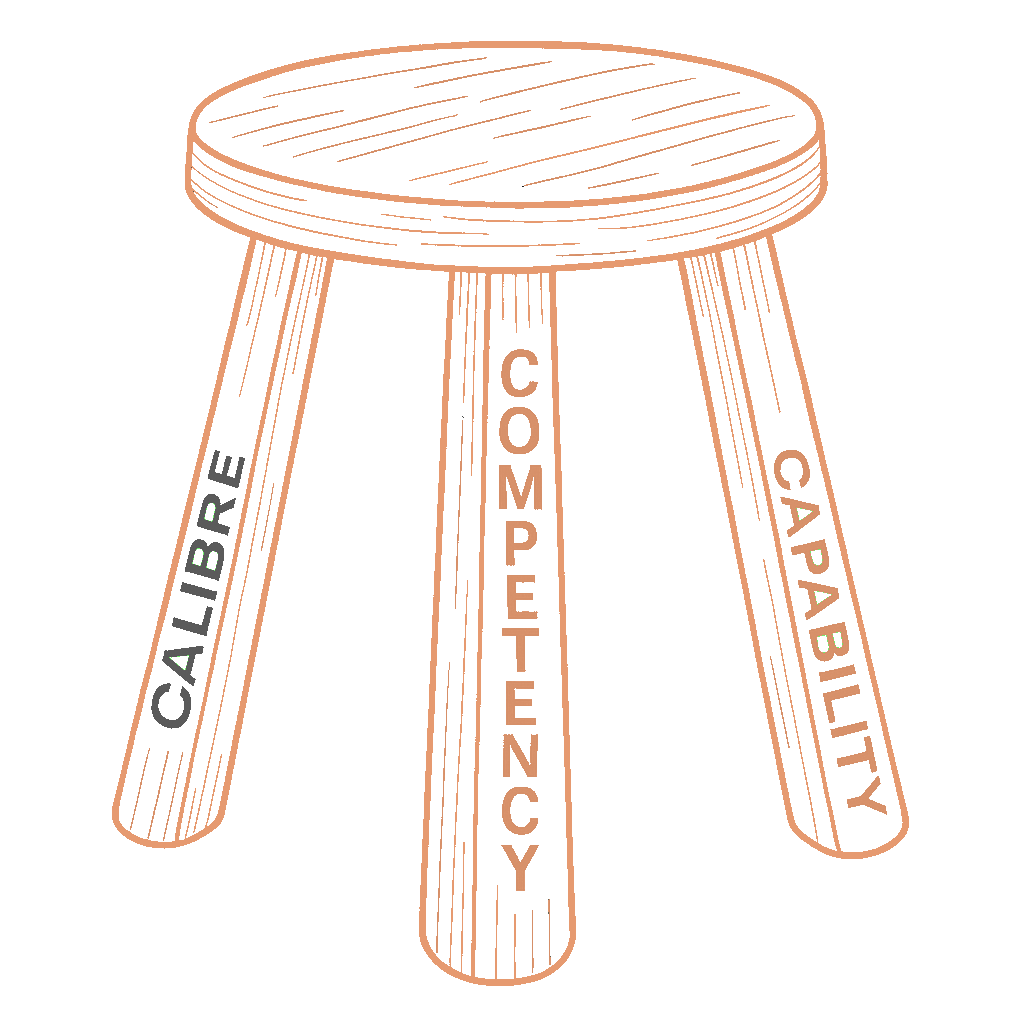 The IOWL Leadership Stool™
Values language
IOWL uses several values-related terms deliberately. They should not be treated as synonyms.
Human condition
Personal Values
What an individual actually values.
Personal Values may be positive, negative, conflicted, unexamined or inconsistent. Simply describing something as a personal value does not make it positive.
Declared position
Espoused Values
The values a person, team or organisation says it holds or wishes to represent.
Espoused Values may or may not be consistently reflected in actual judgement and behaviour.
The distinction between Personal Values and Espoused Values matters because stated values can differ from the values revealed under pressure.
PVL baseline
Positive Values
The explicitly positive, defined values within the Positive Value Leadership™ framework that provide a common baseline for reflection, judgement and development.
PVL does not ask people to surrender their own positive values. It establishes a common baseline beneath them. Individuals, teams and organisations can add further positive values, but they do not begin from a blank sheet.
PVL framework
Positive Value Leadership™ (PVL)
IOWL's structured framework for developing Calibre through Positive Values, reflection, judgement and values-led agency.
PVL uses 24 Positive Values grouped within six Exemplars: Probity, Potency, Planet, People, Perception and Participation.
PVL is not simply "values-based leadership" with values selected independently by each person or organisation. It begins from a common explicitly Positive Values baseline.
Transformation, agency and continuing development
IOWL distinguishes learning about values from the deeper developmental process through which values become more consciously examined, applied and internalised.
Development process
Reflective Transformation
The structured developmental process through which awareness, reflection and repeated examination of Positive Values can change how an individual interprets situations, makes judgements and exercises agency.
IOWL describes the developmental movement as Awareness > Interactions > Influence > Ingestion > Impact > Internalisation, with Reflection, Reinforcement and Rigour operating throughout.
Values-led agency
Integrous Agency
The capacity to act with integrity and Positive Values when circumstances create pressure, fear, conflict, convenience or incentives to do otherwise.
It includes responsible choice, challenge, resistance to complicity, consequence-awareness and willingness to act rather than rely only on position or instruction.
Integrous Agency is not limited to people holding formal leadership positions.
Leadership expression
Integrous Leadership
The ethical and values-governed exercise of power, responsibility and influence.
Within IOWL, formal leadership increases the scale of potential consequence, but Calibre and Integrous Agency remain relevant to leaders and non-leaders alike.
Lifelong architecture
Perpetual Calibre Development™ (PCD)
IOWL's lifelong, need-led and contextually driven architecture for continuing Calibre development as roles, responsibilities and circumstances change.
PCD uses Hindsight, Insight and Foresight to support continuing reflection and development rather than treating Calibre as completed by a single course or award.
PCD complements Continuing Professional Development. CPD commonly develops professional Capability and Competency. PCD addresses the continuing development of Calibre.
Recognition and evidence
IOWL distinguishes participation, developmental recognition and professionally assessed Calibre evidence. Not every IOWL stage or document carries the same meaning.
Assessed recognition
Calibre Credits™
IOWL recognition awarded through the Global Institute for Calibre & Integrity™ following successful completion of the applicable learning and formal assessment requirements on eligible assessed professional pathways.
Successful eligible pathways can award 31 to 50 Calibre Credits™.
Calibre Credits are not academic credits, CPD attendance points, a personality score, a character score or a numerical rating of moral worth.
Professional recognition
Statement of Professional Standing
The formal IOWL record of recognised professional standing arising from successful completion of the applicable assessed professional pathway and relevant IOWL requirements.
It gives individuals and organisations a portable representation of standing alongside other academic and professional evidence.
Combined evidence
Passport of Probity™
The portable IOWL record bringing together the holder's professional standing and Calibre evidence within the continuing professional journey.
It supports verification, discussion and continuing PCD rather than representing a permanent guarantee of future behaviour.
Recognition principle
Professional Standing
Recognised IOWL status associated with successful completion of the applicable professional pathway and the standards required for that standing.
Professional Standing and Calibre Credits are related but distinct forms of recognition. One should not be used as a casual synonym for the other.
Employability language
IOWL separates employment, being employable and employability because they describe different things.
Employment state
Employment
The state of having work or holding a job.
Employment is an outcome or current circumstance. It is not the same thing as employability.
Candidate condition
Employable
Possessing characteristics, evidence and readiness that make employment realistically attainable in a given context.
A person can be employable without currently being employed, and employed without necessarily having strong continuing employability.
IOWL working definition
Employability
The evolving capacity of an individual to obtain opportunity, perform effectively, remain relevant, progress and contribute increasing value within work.
IOWL therefore treats employability as dynamic. It concerns value before entry, at entry, through performance and as responsibility grows.
IOWL progression model
Employability Progression™
IOWL's model describing the increasing strength of an individual's proposition to employers as Calibre awareness, development and professionally assessed evidence increase alongside Capability and Competency.
The progression labels are employer-value positions, not guaranteed labour-market outcomes and not claims that any individual is literally irreplaceable.
Aspirant Access
Noticeable
Beginning to differentiate beyond conventional qualifications and skills through engagement with Calibre.
Cornerstone
Preferable
Developing Calibre awareness and intent that can add a further positive signal where candidates are otherwise comparable.
Basal and Bedrock
Valuable
Increasing evidence of structured commitment to deliberate Positive Value Leadership development.
Foundation and above
Indispensable
The ambition to become increasingly trusted, relied upon and selected for greater responsibility through professionally assessed Calibre evidence.
Trust, trustworthiness and integrity
IOWL treats trust as an outcome of experience rather than another value that can simply be declared.
Relational outcome
Trust
The confidence or willingness to rely on a person, organisation or institution.
Within IOWL, trust is not another layer of the Axiological Pyramid. It is what can emerge when the layers are sufficiently aligned and conduct repeatedly proves worthy of reliance.
Condition
Trustworthiness
The qualities and demonstrated conduct that make reliance more warranted.
IOWL's proposition is that sustainable trustworthiness is built from the inside out, while regulation and formal control necessarily operate from the outside in.
Core quality
Integrity
Coherence between principles, judgement, responsibility and conduct, including when pressure or personal interest makes that coherence difficult.
Integrity is central to Calibre but is not used by IOWL as a casual guarantee that an individual will always act correctly.
PVL Exemplar
Probity
The Positive Value Leadership Exemplar concerned with the responsible use of position, influence and authority, including the willingness to challenge conduct that may cause harm.
Probity is one of six PVL Exemplars and should not be used as a synonym for the whole Calibre framework.
IOWL models and architecture
Several IOWL models explain different parts of the Calibre proposition. They should be used together rather than collapsed into one metaphor.
IOWL contention
Capacity Conundrum™
The recurring institutional and societal error of attempting to build greater capacity without giving equivalent attention to the Calibre governing how that capacity is exercised.
The Capacity Conundrum does not argue against education, skills, technology or human-capital investment. It asks what governs their use.
IOWL model
Leadership Stool™
The three-legged IOWL model showing Capability, Competency and Calibre as distinct but mutually necessary dimensions of dependable human performance.
Remove any one leg and the model becomes unstable.
IOWL model
Axiological Pyramid
The IOWL model describing the strata through which human judgement is expressed, aligned, guided, governed and constrained: Values, Morals, Organisational Values, Ethics, Governance and Compliance.
The model distinguishes inside-out development from outside-in systems of professional, organisational and external control.
Human-capital metaphor
Moral Mortar
IOWL's metaphor for Calibre as the cohesive human dimension connecting capacity-building investments to more dependable use.
The bricks represent areas such as education, knowledge, skills, experience and health. The mortar represents the judgement, integrity and values-governed agency through which those capacities are brought into use.
Continuing judgement model
Hindsight > Insight > Foresight
A continuing reflective sequence used within IOWL to learn from what has happened, understand what is happening now and anticipate the consequences of what may happen next.
The objective is to strengthen foresight so that responsible action occurs before poor judgement becomes a visible failure.
Evidence discipline
Emerging Evidence
IOWL's public approach to separating observed learner evidence, independent external context, developing longitudinal evidence and IOWL-authored research propositions.
External research that converges with IOWL's propositions is not presented as proof that Calibre or PVL caused the external finding.
The six axiological strata
The preferred IOWL meanings within the Axiological Pyramid are summarised below.
ValuesPersonal, internal and capable of being examined.
MoralsSocially influenced judgements and expectations.
Organisational ValuesContextual commitments established within an organisation.
EthicsProfessionally determined expectations of conduct.
GovernanceInternal organisational systems of direction, control and accountability.
ComplianceExternal requirements including law, regulation and mandated standards.
Terminology note: some terms on this page are ordinary words used in a specific IOWL context; others are IOWL concepts, frameworks or protected marks. IOWL distinguishes public evidence methodology - how published evidence is collected, scoped, calculated and interpreted - from protected IOWL methodology and know-how, including detailed assessment, calibration, weighting, decision, integrity, anti-gaming and implementation mechanisms. The former is explained sufficiently for scrutiny of published evidence; the latter is not publicly disclosed. This page establishes preferred public wording but does not replace the formal intellectual-property register. See Trademarks & Intellectual Property >
One language for Calibre across education, work and society.
Consistent language makes the IOWL proposition easier to understand, research, apply and recognise across learners, employers, universities, professional bodies, government and public life.
Explore the Calibre & Impact Map Explore IOWL pathways