 Ask Athena
IOWL foresight | thinking initiated in 2013
The Capacity Conundrum™
Why expanding education, skills, knowledge and capability without equivalent attention to the Calibre governing their use creates a structural vulnerability for people, organisations, productivity, institutions and society.
The thinking that eventually became Positive Value Leadership™ began in 2013 with a contradiction. Advanced economies were investing heavily in education, qualifications, professional development, technology and workforce skills. People were becoming more knowledgeable and, in many fields, extraordinarily capable. Yet the same societies continued to experience institutional failure, poor leadership, serious misconduct, weak productivity growth and declining confidence in the organisations upon which public life depended.
That presented a difficult question. If education and skills were continually improving human capability, why did greater capability not reliably produce better outcomes?
The conventional response was generally to seek still more capability: close another skills gap, create another qualification, introduce more training, strengthen a process or add further regulation. IOWL began by questioning the premise.
What if the problem is not simply what people are capable of doing, but what governs how they choose to use that capability?
That question eventually led to what IOWL describes as the Capacity Conundrum™ - and ultimately to an architecture for developing, evidencing and recognising Calibre.
A blind spot hiding in plain sight
Education systems have a clear purpose. They develop knowledge, understanding and intellectual capacity. Universities develop disciplinary and professional capability. Employers and experience develop competency, allowing people to apply what they know more effectively. Governments invest in skills because a more capable workforce should increase economic capacity and productive performance.
Each part of that logic is reasonable. The difficulty arises when those systems are assumed to tell us something they do not.
A degree can tell us that an individual has reached a particular academic standard. A professional qualification can demonstrate technical competence. Employment history may indicate previous performance. None necessarily tells us how the individual will exercise judgement when pressure, personal interest, organisational incentives and responsibility collide.
Will they share information when withholding it would benefit them? Will they challenge a decision when remaining silent would be easier? Will they use expertise to clarify a problem or to obscure it? Will they comply merely with the wording of a rule, or also understand its purpose?
These are not questions of capability alone. They are questions of Calibre. IOWL came to regard this as an HR and human-capital blind spot: increasingly sophisticated systems for measuring what people know and can do, accompanied by much weaker systems for examining the quality of judgement governing the use of that capacity.
2008 exposed the problem at scale
The global financial crisis cannot sensibly be attributed to one factor. Macroeconomic conditions, regulatory failures, governance weaknesses, incentive structures, risk management and institutional complexity all played important roles. But it was also striking that the crisis did not emerge because the financial system lacked intelligent, educated or technically capable people.
Quite the opposite. Some of the most serious failures occurred inside institutions filled with highly qualified professionals who understood complex products, markets, regulation and risk. The US Financial Crisis Inquiry Commission subsequently concluded that there had been a systemic breakdown in accountability and ethics, alongside widespread failures in regulation and corporate governance. In the UK, official discussion of the RBS failure criticised poor judgement, aggressive risk-taking and a regulatory culture that became too reactive and tick-box oriented rather than exercising sufficient judgement and foresight.
For IOWL, this mattered because it exposed a distinction that remains central to the Calibre proposition. A person can be exceptionally capable and still exercise poor judgement. Greater capability can actually make poor judgement more consequential because expertise, authority, information and technology increase the scale of what one person or institution can affect.
It also encouraged a different use of hindsight. Instead of looking only at the point at which failure became visible - a breached rule, failed governance process, professional lapse or institutional collapse - the more useful question was what had been developing underneath those visible consequences. The 2008 crisis therefore became one important lens through which IOWL began separating root cause from signs, symptoms and remediation.
Primary-source context: US Financial Crisis Inquiry Commission Report; UK Government statement on the FSA report on RBS.
The relevance of the 2008 case is specific: official inquiries demonstrate that failures of judgement, accountability, governance and ethics were material within a highly capable system. IOWL uses the case as a hindsight lens on the human dimension within a multi-causal institutional failure.
Doing things right and doing the right thing
This is where the distinction between doing things right and doing the right thing becomes important.
Doing things right concerns competence, procedure and execution. It asks whether the process has been followed correctly and whether the task has been performed effectively. Doing the right thing introduces another dimension. It requires judgement about purpose, responsibility, consequence and values.
Ideally the two coincide. Sophisticated systems, however, create opportunities for them to separate. A professional may remain inside the literal wording of a regulation while frustrating its intention. A manager may comply with procedure while treating people unfairly. An organisation may satisfy a reporting requirement while withholding information necessary for others to understand the true position.
The more technically sophisticated the environment, the easier it may become for capable people to discover the space between what is expressly prohibited and what responsible conduct requires. This is why rules alone cannot solve every integrity problem. Rules operate outside the individual. Judgement operates within them. A resilient system requires both.
Capability has no moral direction of its own
Capability is powerful precisely because it increases what a person can do. A surgeon can use expertise to save life. A software engineer can build systems that improve life for millions. A financier can direct capital towards productive activity. A scientist can solve problems that previous generations could not. The same underlying capacity can also be used irresponsibly.
CapabilityCan I do this?
Knowledge, understanding and the capacity to act.
CompetencyCan I do it effectively?
The practical ability to apply capability and perform.
CalibreShould I - and how?
Judgement, integrity, responsibility, consequence-awareness and the values governing the use of capability.
Human performance needs all three legs
The IOWL Leadership Stool™ makes the proposition visible. Capability, Competency and Calibre are distinct, but dependable performance requires all three to operate together.
Capability provides knowledge, understanding and capacity. Competency provides the practical ability to apply that capacity effectively. Calibre concerns the judgement, integrity, responsibility and Positive Values governing how both are exercised.
Remove any one leg and the stool becomes unstable. The IOWL argument is therefore not Calibre instead of skills or knowledge. It is that the human-performance model is incomplete when one of its three supporting dimensions is left largely to assumption.
The Capacity Conundrum begins when societies invest heavily in Capability and Competency while assuming that Calibre will develop by itself.
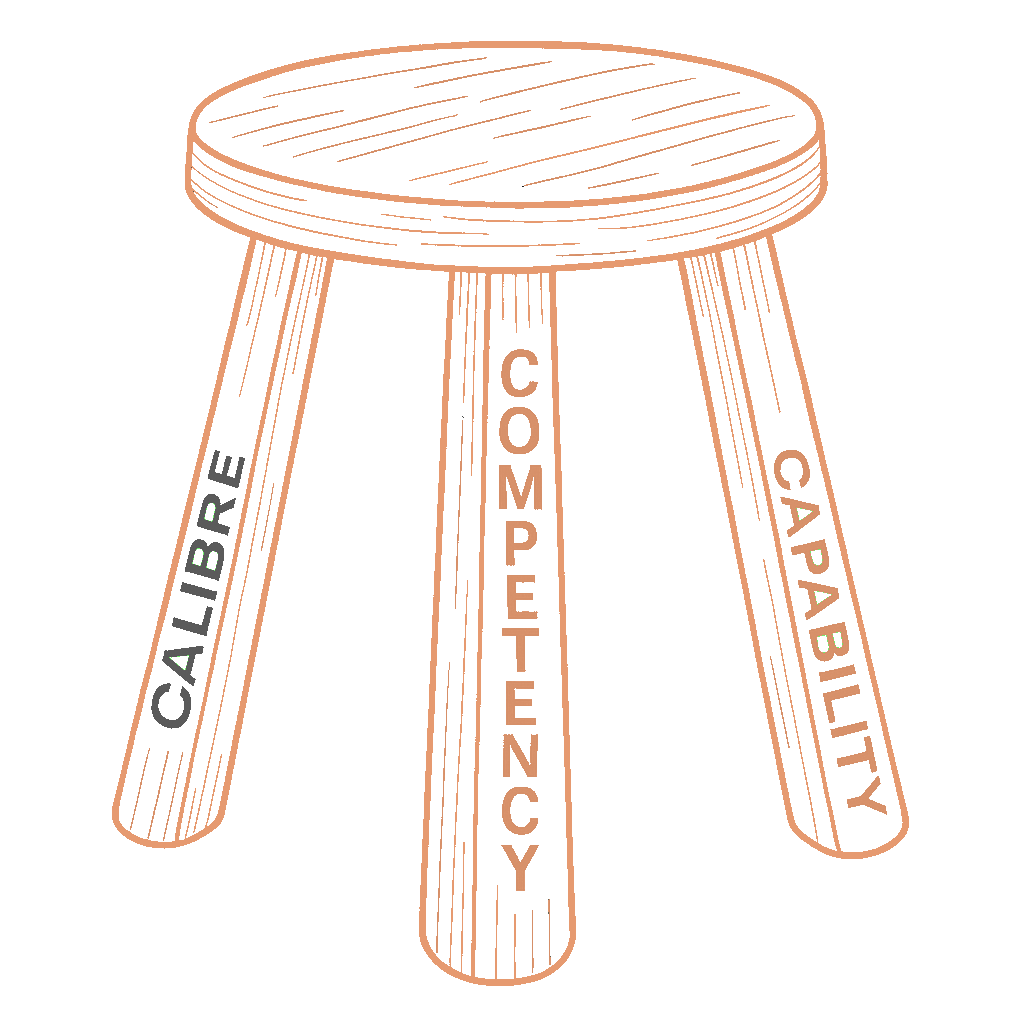
The IOWL Leadership Stool™: Capability + Competency + Calibre.
Calibre does not diminish capability. It helps govern its direction. As capability increases, the consequences of how that capability is exercised can increase with it.
Terminology: IOWL uses Capability, Competency and Calibre as distinct terms. See the Calibre Language & Definitions reference for the preferred meanings used across this architecture.
The Capacity Conundrum™
The Capacity Conundrum™ is the recurring institutional and societal error of attempting to build greater capacity without giving equivalent attention to the Calibre governing how that capacity is exercised.
Societies continually invest in education, health, knowledge, skills, experience and technology. These investments build human capital, and that is desirable. But greater human capital creates greater capacity to produce consequences, not an automatic guarantee that those consequences will be positive.
A highly capable workforce can produce extraordinary innovation. It can also reproduce an ineffective culture more efficiently. A sophisticated organisation can solve complex problems. It can also conceal poor decisions behind complexity. A powerful technology can improve millions of lives. It can also scale bias, misinformation or poor judgement far beyond the reach of any single human decision.
Capacity increases possibility. Calibre helps determine direction.
The wall is not held together by bricks alone
One way of understanding the problem is to look at how governments and institutions organise society to build capacity. Education, health, skills, knowledge, experience and employment are commonly arranged into functional policy blocks, often administered through different departments, professions, funding streams and institutional systems. Each block can strengthen human capital. Each can increase what a population, workforce or organisation is capable of doing.
Education
Knowledge
Skills
Experience
Health
Calibre - the moral mortar connecting capacity to dependable use
The problem is not the bricks. The problem is the largely unquestioned assumption that enough good bricks will automatically produce a strong wall. A wall is not held together by the quality of its bricks alone. Without mortar, the materials may be individually strong and the structure may stand for some time. Its weakness becomes visible when pressure is applied.
IOWL uses the metaphor of Calibre as the moral mortar of human capital: the judgement, integrity, responsibility, humanity, consequence-awareness and values-governed agency through which capability becomes more dependable.
Capacity architecture
The blocks show what society builds
Education, health, knowledge, skills and experience create productive human capacity. They answer the question: what resources and capabilities have we developed?
Axiological architecture
The pyramid shows what governs their use
Values, morals, organisational commitments, professional ethics, governance and compliance show the progressively wider strata through which human judgement is expressed, aligned, constrained and assured. They answer a different question: can we depend upon how that capacity will be exercised?
The axiological strata of trustworthiness
The second model looks beneath capacity and asks what makes the exercise of that capacity dependable. IOWL's Axiological Pyramid places personally developed and held values at the foundation, with wider social, organisational, professional, governance and compliance strata above them.
The pyramid is not intended to suggest that one layer can replace another, or that law, governance and professional ethics are unimportant. It shows something different: where the source of behavioural guidance progressively moves from internal understanding towards external imposition.
At the foundation, values are personal and internal. Morals are shaped socially. Organisational values add contextual commitments. Ethics adds professionally determined expectations. Governance imposes internal organisational controls. Compliance ultimately reflects the laws, regulations and external requirements within which the person and institution must operate.
These layers are therefore best understood as axiological strata of trustworthiness. Trust itself is not another block at the top of the pyramid. Trust is an outcome that becomes more plausible when the strata are coherent and the conduct they produce is repeatedly worthy of it.
ComplianceExternal requirements - laws and regulation
GovernanceInternal organisational control
EthicsProfessionally determined expectations
Organisational ValuesContextual commitments
MoralsSocially influenced understanding
ValuesPersonal, internal and increasingly examined
InternalContextualProfessionalInstitutionalExternal
Alignment creates structural stability.
When the foundation is sufficiently developed and the layers above are broadly aligned with it, the structure is more coherent: what the person believes, what the organisation expects, what the profession requires, how the institution governs and what the law demands pull in broadly compatible directions. When those strata are materially out of alignment, the upper layers must carry more of the burden through supervision, control, sanction and enforcement. The structure may still stand, but it is increasingly fragile under pressure.
Inside-out trustworthiness and outside-in control
This distinction creates a fresh perspective on prevention. External rules and governance work primarily from the outside in. They tell people what they must do, what they may not do and what will happen if they breach the required standard. Positive Values development works from the inside out. It seeks to strengthen the judgement from which behaviour originates, so that responsible conduct is not dependent only upon surveillance or the presence of a rule.
Inside out - prevention and foresight
Develop values, self-awareness, social awareness, judgement and consequence-awareness before a poor choice becomes an ethical problem, governance failure or compliance event.
Outside in - control and remediation
Use professional standards, governance, laws and regulation to guide, constrain and remediate behaviour where internal judgement alone cannot be relied upon.
The two approaches are complementary. IOWL is not arguing for fewer laws, weaker governance or the abandonment of professional ethics. The point is that upper-layer controls should not be expected to compensate indefinitely for an underdeveloped or conflicted human foundation.
Compliance can constrain behaviour. Positive Values can help govern it from within.
The aim is not fewer rules. It is fewer occasions on which rules have to compensate for weak judgement.
The aim is not fewer rules. It is fewer occasions on which rules have to compensate for weak judgement.
From hindsight to foresight: looking beneath the visible failure
The Axiological Pyramid also changed the direction of the enquiry. Conventional failure analysis often begins where the damage becomes visible: an investigation follows an incident, governance is strengthened, professional guidance is revised or regulation is expanded. This is necessary hindsight, but it starts near the top of the pyramid, after a problem has already travelled through the system.
IOWL's developing perspective was to use hindsight differently. Instead of asking only which control failed?, ask what human judgement, assumption, incentive, behaviour or values conflict allowed the problem to incubate before the control was tested? That moves attention downwards towards root cause.
From there, insight and foresight become possible. Insight asks what is happening now, what pressures are operating and what the individual is contributing to the situation. Foresight asks what is likely to happen next if nothing changes, who may be affected and what responsible action should be taken before the consequence materialises.
This is one reason the 2008 financial crisis remained important to IOWL's thinking. The lesson was not that a single missing value caused the crisis, nor that Positive Value Leadership would have guaranteed its prevention. The more defensible insight was that a highly capable system had experienced interacting failures of judgement, ethics, governance and accountability, while subsequent responses necessarily concentrated heavily on upper-layer controls. IOWL's question was whether a more preventative architecture could also work lower in the pyramid, strengthening the human foundation before failure became a matter for remediation.
The developmental shift is from reacting to failure with hindsight towards using insight now to build foresight before action.
Government evidence reinforces the limitation of a skills-only explanation
The same issue appears in productivity policy. Education and skills are routinely - and rightly - presented as central mechanisms for improving economic performance. Yet UK Government analysis itself demonstrates that skills are not the whole productivity story.
The Department for Education's 2023 Skills and UK productivity report examined how educational attainment contributes to UK productivity growth. Subsequent UK Government policy has summarised the result clearly: approximately one third of average annual productivity growth from 2001 to 2019 was due to general skills improvement.
That is a substantial contribution. It is also revealing. Strong evidence for the importance of skills simultaneously demonstrates that productive performance cannot be understood through skills alone.
The better question is not simply "How do we produce more skills?" It is "What determines whether those skills are converted into constructive, dependable performance?"
Primary-source context: Department for Education, Skills and UK productivity (2023); Get Britain Working White Paper.
The policy contention is that Calibre is a candidate multiplier in the conversion of productive inputs. The research proposition tests how far defined Calibre dimensions help explain why apparently comparable stocks of human capital, skill and capability produce different realised outcomes.
Without values, skills are not a solution. They are a variable.
Two organisations can employ similarly qualified people and achieve very different outcomes. Two teams can possess comparable technical expertise and perform very differently. Two leaders may possess similar education, experience and authority and yet create entirely different organisational cultures.
The difference cannot always be explained by capability. Performance is affected by the way people communicate, share information, respond to challenge, exercise judgement, collaborate, accept responsibility, manage disagreement and use authority. A highly skilled person who withholds information can reduce the performance of an entire team. A technically brilliant manager who discourages challenge may make poorer decisions because colleagues stop speaking. A capable organisation whose incentives reward the wrong behaviour can direct extraordinary expertise towards undesirable outcomes.
Skills therefore enlarge the range of possible outcomes. They do not determine which outcome will occur.
((Health + Education + Knowledge) × (Capability + Competency)) × Calibre = Productivity
IOWL canonical productivity relationship: this is the policy contention used in IOWL's written evidence to the UK Parliament Business and Trade Committee and its Irish Government position paper. It expresses Calibre as the missing multiplier through which productive inputs can be strengthened or diminished. It is a conceptual relationship rather than an arithmetic or econometric identity; empirical work tests the pathway through realised performance and productivity.
Productivity, integrity, education and trust are not separate conversations
One reason the Capacity Conundrum can remain difficult to see is that its consequences are discussed in different policy silos. Education is discussed as an education problem. Skills are discussed as a labour-market problem. Productivity is discussed as an economic problem. Integrity is discussed as a compliance or governance problem. Trust is discussed as a political or institutional problem.
Yet the same human judgement runs through all of them.
EducationDevelops knowledge and increasingly addresses values, attitudes, agency and participation.
ProductivityDepends not only on possessing human capital and skills but on how productive capacity is organised and used.
IntegrityDepends on implementation and behaviour in practice, not only the existence of formal rules and standards.
TrustDepends on repeated experience of competent, fair, reliable, open and responsible institutional conduct.
OECD work makes these connections increasingly visible. Its 2018 paper Investing in Integrity for Productivity concludes that productivity policies, including investment in skills, can lose effectiveness when the wider governance and integrity framework is overlooked. Crucially, the OECD describes that framework as shaping the decisions made by individuals about whether resources are directed towards productive or unproductive activity. The same paper presents integrity as a condition for productivity growth and reports evidence linking corruption, resource misallocation, trust and multifactor productivity.
IOWL treats this as external convergence, not proof of Calibre. The OECD argument operates principally through institutions, governance and integrity systems. The IOWL research proposition asks the next question: if those systems themselves depend upon human judgement, what governs the judgement of the people operating within them? That is the point at which the Axiological Pyramid moves attention from necessary upper-strata control towards the values foundation beneath it.
Independent context: OECD, Investing in Integrity for Productivity; OECD, Building trust through education. IOWL's Emerging Evidence page explains how independent context is kept distinct from observed PVL evidence and IOWL-authored research propositions.
Trust is a performance issue, not merely a reputational issue
Trust affects whether people cooperate, whether staff speak openly, whether citizens accept institutional decisions, whether customers believe organisations, whether professionals share information and whether people comply voluntarily rather than only under threat of sanction. Low trust creates friction, and friction creates cost.
An organisation cannot communicate its way out of conduct that repeatedly demonstrates poor judgement. Trust has to be earned through behaviour. Policies do not make decisions. Strategies do not exercise discretion. Values statements do not challenge wrongdoing. People do.
Institutional Calibre therefore depends substantially upon the Calibre exercised by the individuals within the institution. The same logic is visible across the recurring failures mapped in IOWL's Calibre Issue & Solution Map.
Government and public service make the Capacity Conundrum especially visible because public capability, authority, regulation and service delivery all depend upon human judgement at the point of implementation.
See the Capacity Conundrum applied to Government & Public Service >
Why regulation alone cannot close the gap
Following failure, institutions understandably create more rules. Sometimes this is essential. But every rule eventually meets a human being. Someone interprets it. Someone decides how seriously to apply it. Someone chooses what information to disclose. Someone decides whether to challenge an apparent breach. Someone finds the loophole. Someone decides whether the loophole should be used.
External regulation can therefore never remove the need for internal judgement. Regulation asks: What am I permitted or required to do? Calibre adds: What is responsible, fair and the right thing to do?
The two should reinforce each other. The mistake is believing that the first can permanently substitute for the second.
The significance of 2013
By 2013, the central IOWL question was therefore no longer simply whether values mattered. That had been argued for centuries. Nor was the answer to create another ethics course and add it to the existing stack of education, professional standards, governance and compliance.
The fresh perspective was to understand how the layers interact: where personally held values meet socially shaped morals; where organisational commitments meet professional ethics; where governance attempts to align behaviour internally; where compliance imposes requirements externally; and what happens when those strata reinforce one another - or pull in different directions.
That required distinguishing root cause from signs and symptoms, prevention from remediation, and internal judgement from external imposition. It required using hindsight to understand failure, insight to interpret the present and foresight to anticipate consequence before action. Only then did the practical developmental question become clear: could the human foundation itself be deliberately strengthened, evidenced and sustained?
But once values had been identified as the foundation, another weakness in conventional values-led thinking became impossible to ignore: the word "values" does not mean "Positive Values" automatically. Values-driven approaches often invite individuals or organisations to identify the values that matter to them, implicitly assuming that those values will be constructive. Yet people can hold negative or self-serving values, espouse one set publicly while enacting another privately, or select positive values so selectively that no common baseline remains between people and institutions.
IOWL therefore concluded that the foundation itself could not be left blank. It required an explicitly Positive Values baseline - broad enough to provide continuity across people, organisations and cultures, but open enough for additional positive values to be added in context. That reasoning led to the 24 defined Positive Values organised through six Exemplars.
Why 24 Positive Values? - explore the common baseline >
From there, answering the wider developmental question required an integrated architecture: the Positive Values baseline; developmental progression from self-awareness into interaction, influence, consequence and internalisation; a language of agency; Reflection, Reinforcement and Rigour; assessment capable of distinguishing knowledge acquisition from Reflective Transformation; formal recognition through Calibre Credits™; and Perpetual Calibre Development™ because Calibre must continue to develop as responsibility, capability and circumstance change.
That sequence ultimately produced Positive Value Leadership™, Calibre Credits™ and Perpetual Calibre Development™ - integrated into the wider IOWL Calibre architecture.
See how the architecture develops, evidences and recognises Calibre >
Correcting the Capacity Conundrum does not mean abandoning skills
The IOWL argument is not anti-skills. It is the opposite. The more capability society creates, the greater the need to ensure that capability is used well. Universities should continue developing knowledge and intellectual capacity. Professional education should continue developing specialist expertise. Employers should continue strengthening competency. Governments should continue investing in workforce skills.
The correction is simply to recognise that these investments are incomplete when Calibre is left to chance. The Leadership Stool™ shown earlier is deliberately a three-legged model: Capability + Competency + Calibre. Removing Capability or Competency would make the model just as unstable as removing Calibre. Each contributes something the others cannot.
Universities are central to solving the Capacity Conundrum because they develop enormous amounts of human capability. The sensible response is not to ask each university to reinvent itself as a specialist Calibre institution. IOWL's proposition is complementary: universities develop capability, professional practice develops competency, and IOWL provides a specialist para-curricular architecture through which Calibre can be deliberately developed, evidenced and recognised alongside them.
From employable to indispensable
A degree may help demonstrate that a graduate is capable. Experience may demonstrate growing competency. But the employer eventually confronts a different question: Can we depend upon how this person will use what they know?
As responsibility grows, the individual gains access to information, discretion, influence and authority. They may manage budgets, represent the organisation, design systems, manage teams or exercise professional or public responsibilities. At that point, judgement, reliability, responsibility and values-governed agency become increasingly important to the value the person creates.
This is the progression from being merely employable towards becoming increasingly indispensable to employers - not because any person is literally irreplaceable, but because dependable Calibre strengthens the value of capability and competency already present.
The proposition
More education is desirable. More knowledge is desirable. More skills are desirable. More capability is desirable.
But increasing what people can do without equivalent attention to how they choose to use that capacity creates a structural vulnerability. The bricks may increase capacity while the axiological strata governing trustworthiness remain weak or misaligned. That vulnerability affects organisations, institutions, productivity, public confidence and society.
The missing question is not simply "How capable are our people?" It is "What governs the use of their capability?"
That is the Capacity Conundrum™. And it is the problem IOWL has spent more than a decade building an architecture to address.
Explore the connected Calibre architecture
The Capacity Conundrum explains the problem. The linked pages show the developmental mechanism, evidence base, relationship architecture, real-world applications and protected intellectual property.
Basis of CalibreReview the construct, assessment, recognition boundaries and practical basis of IOWL's custodial role.
Why 24 Positive Values?Why PVL required a common, explicitly positive baseline rather than a blank values framework.
From Positive Values to Calibre Credits™How PVL transformation is developed, assessed, protected and recognised.
Emerging EvidenceObserved learner outcomes, independent context and testable research propositions.
Calibre & Impact MapExplore the relationships between human capital, Calibre, performance, trust and society.
Issue & Solution MapSee recurring failures of judgement, integrity, information and participation through PVL.
Trademarks & IPUnderstand IOWL's protected concepts, frameworks, systems and methods.
University PartnershipsSee how universities can add Calibre without attempting to replicate the architecture.
Calibre Language & DefinitionsUse the canonical IOWL meanings of Capability, Competency, Calibre, Positive Values, recognition and trustworthiness.
Government & Public ServiceSee how the Capacity Conundrum applies to public responsibility, service delivery, integrity, governance and public trust.
Work Experience Is Not EmployabilityApply the Capacity Conundrum to graduate employability, work-based learning and the current workforce.
Who Gives AI Its Values?Apply the same Capability-Calibre distinction to AI alignment and human judgement.
IOWL Publications & PapersRead authored analyses, position papers and developing propositions across the IOWL architecture.