 Ask Athena
Employer Partnerships | Compliance and Assurance
Move from knowing the rules to applying them with calibre.
Compliance defines what must be done. Calibre strengthens the judgement, responsibility and courage people need when rules meet pressure, competing interests, ambiguity or the need to speak up.
Discuss compliance deployment Employer overviewComplianceConductSelf-correctionIntegrity Assurance
Doing things right is necessary. So is doing the right thing.
Laws, regulations, policies and controls establish how things must be done. Organisations also depend on people recognising when conduct, incentives, pressure or local practice are pulling them away from the purpose those rules are meant to protect.
Positive Value Leadership™ develops the Calibre behind compliance: judgement, responsibility, values-led agency and the willingness to stop, think, challenge and respond appropriately.
Compliance use case: use PVL before incidents in roles of trust, after recurring findings where behaviour remains part of the problem, or as part of a wider culture and integrity programme.
Organisation-level deployment: this page is for employers considering how Calibre can sit alongside policies, controls, assurance and organisational conduct. The separate professional guide is for individual compliance, risk, governance and integrity practitioners.
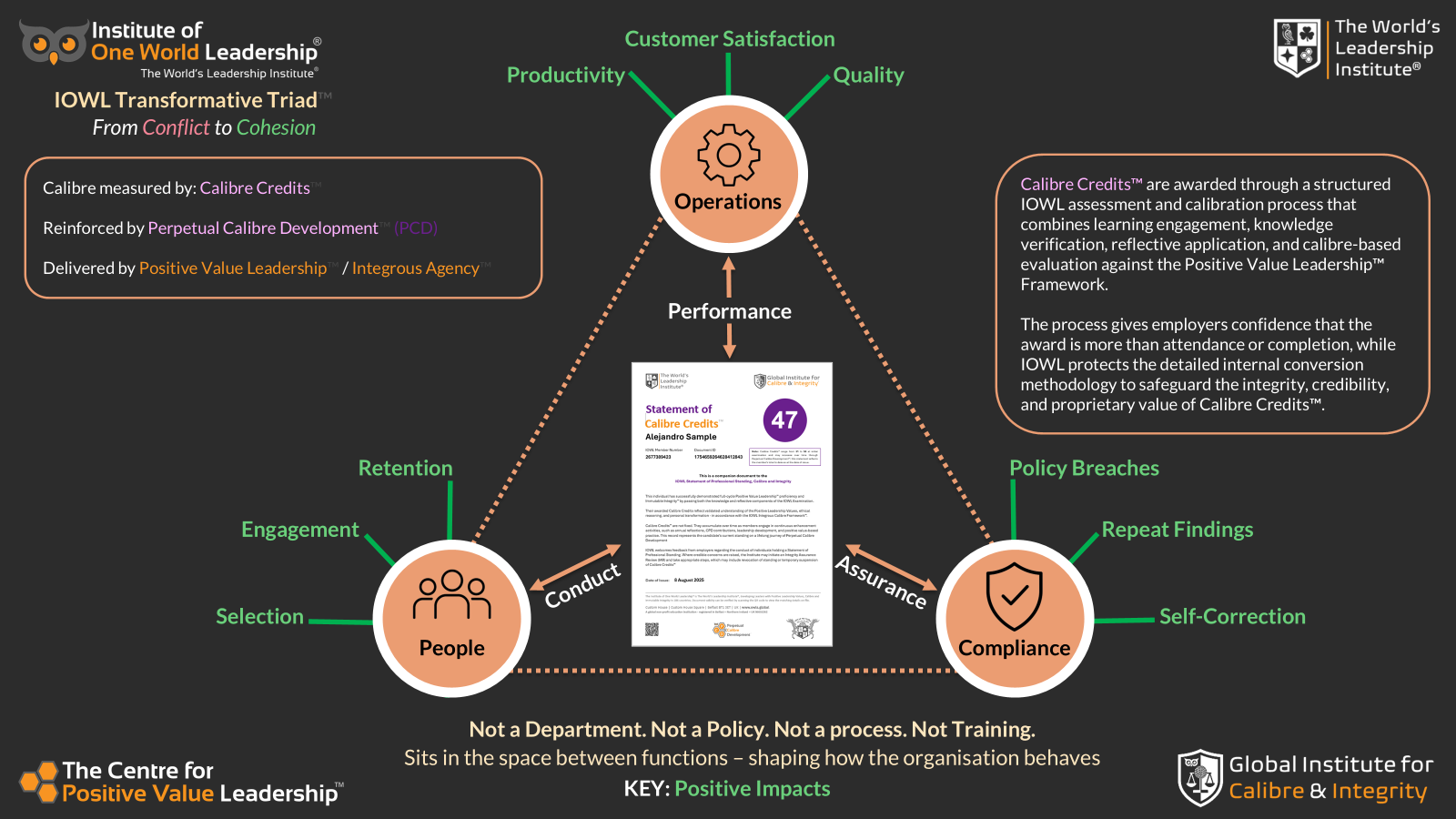
Where compliance and assurance leaders can use IOWL
IOWL addresses the human Calibre layer without replacing technical compliance, legal advice or control ownership.
Before
Strengthen judgement in higher-risk roles
Use PVL where confidentiality, financial responsibility, public trust, safety, regulatory judgement or significant discretion make conduct especially important.
After
Address the people dimension of recurring findings
Where policies and training have already been refreshed but similar issues recur, add a structured Calibre intervention rather than repeating the same response.
Throughout
Build self-correction into culture
Develop the confidence to question, disclose, escalate and correct emerging problems before they become normalised or require formal intervention.
Assurance without employer control of the award
Employers can commission and use IOWL pathways, but recognition should never outrun evidence.
What the employer controls
- Which roles or cohorts are sponsored.
- How PVL fits with induction, remediation, progression or assurance activity.
- Internal policies, controls and employment decisions.
- How lawful organisational reporting is used.
What IOWL and GICI control
- Learning and assessment requirements.
- Assessment integrity and threshold decisions.
- Professional standing decisions.
- Calibre Credits™ awarded through the Global Institute for Calibre & Integrity™.
Separation matters: sponsorship or organisational importance cannot purchase a pass, professional standing or Calibre Credits™.
Rules
Compliance establishes what must be done.
Judgement
Calibre strengthens how people respond when circumstances test the rules.
Evidence
Assessment and recognised standing provide a record that development has been tested.
Deploy by level of responsibility
Use the assessed pathway that matches the employee's influence, discretion and organisational impact.
Foundation
Entry and early-career roles
Build a structured Calibre foundation before patterns of conduct and decision-making become embedded.
View Foundation pathwayKeystone
Front-line discretion and supervision
Suitable where employees interpret policy, influence colleagues, deal with customers or make first-line decisions with compliance consequences.
View Keystone pathwayCapstone
Management and governance influence
Suitable where decisions shape culture, incentives, escalation, organisational risk or the integrity of governance arrangements.
View Capstone pathwayFor compliance, risk, governance and integrity professionals
This page explains organisation-level deployment. The specialist professional guide focuses on how individual practitioners can use Calibre across recruitment, higher-trust roles, investigations, challenge, governance, integrity and continuing PCD.
Professional practice guide
Use the professional guide where the starting point is the practitioner rather than the organisation. It connects the Axiological Pyramid, Calibre evidence, recruitment, role progression and PCD to compliance, risk, governance, assurance and integrity practice.
Frequently asked questions for compliance
How IOWL fits alongside established compliance and assurance systems.
No. Technical and regulatory training explains requirements. IOWL develops the Calibre of people who must interpret, apply, question and uphold them responsibly.
No. Employers may sponsor participation and receive agreed reporting, but assessment and recognition decisions remain independent of sponsorship.
Where credible concerns arise, IOWL may initiate the applicable integrity or professional standards review. Any suspension, withdrawal or other action must follow the relevant published process and evidence.
Reporting must be agreed in advance and handled lawfully. Organisational summaries and appropriate verification can be provided without giving unrestricted access to individual learning records.
Build Calibre into compliance culture
Strengthen the judgement and responsibility that sit behind policies, controls and assurance.
Discuss compliance deploymentHow to use Calibre evidenceBack to employer overview