 Ask Athena
Universities already develop knowledge, skills and qualifications.
The next competitive challenge is proving graduate calibre.
The graduate market is changing. More students are competing for opportunity, AI is reshaping entry-level work, and employers are looking beyond technical ability. They increasingly need evidence relevant to judgement, responsible communication, integrity and readiness for responsibility.
That creates a strategic question for every university:
If two graduates have similar degrees, similar skills and similar experience, how can one stand out?
By providing evidence of Calibre, judgement and values-led agency.
The Institute of One World Leadership gives universities a way to add Calibre alongside the Capability and Competency they already develop. Graduate employability is an immediate and important application, but the wider proposition follows the learner beyond the first job into continuing development, professional progression, leadership, integrity, trusted responsibility and sustained performance.
Following registration, My World is the learner's personal point of access to IOWL
For a university reader encountering IOWL for the first time, the relationship is simple. IOWL is the institution and wider Calibre architecture. My World is the individual's personal environment within it.
Under the university access model, the university creates the opportunity and supplies the agreed onboarding data. IOWL validates the record and issues the learner's account-ready invitation. Once the learner completes registration and activation, My World becomes their personal point of access to IOWL.
My World is designed to remain relevant across the learner's whole journey: from university study to graduation, employment, professional progression, increasing responsibility, career change and later-life contribution.
Links marked ↗ open supporting IOWL pages in a new tab so you can explore further without losing your place on this university proposition.
Employability may be where the conversation starts. The IOWL proposition extends across the whole working life.
Employability is one application of a much wider Calibre architecture. IOWL is designed to accompany people as their context, responsibility and influence change - from student life and first employment through progression, professional responsibility, leadership and lifelong contribution.
The purpose is to establish the opportunity early, support registration and activation, make Calibre visible, and give the learner a utility environment they can return to as new needs emerge throughout life.
 My World - a Swiss Army knife for Calibre and professional life
The value is having the utility in the student's pocket from the outset, ready whenever a future situation makes one of those tools relevant.
My World - a Swiss Army knife for Calibre and professional life
The value is having the utility in the student's pocket from the outset, ready whenever a future situation makes one of those tools relevant.
My World is a continuing personal development environment
Once the learner has access, it becomes a living, personalised development environment that can grow in relevance with them. My World can use developmental context such as education, experience, career stage, responsibility, aspirations and current need to guide what is most useful now, while keeping the wider IOWL environment available for later.
For a university, that changes the proposition. Following registration and activation, the student enters a continuing environment that can support study, employability, judgement, progression, professional responsibility, career change and Perpetual Calibre Development™ throughout life.
For the learner
A lifelong environment for Calibre awareness, reflection, development, professional evidence, progression and continuing PCD as circumstances change.
For the university
A strategic Calibre layer connecting student success, employability, graduate attributes, leadership development, employer engagement, alumni and lifelong learning.
For organisations and society
A wider proposition about judgement, integrity, conduct, trust, sustained performance, productivity and the responsible exercise of increasing influence.
Employability is one application of a wider Calibre architecture
Most universities already have employability teams. They support careers advice, CVs, interviews, placements, internships, employer engagement and skills development. These functions matter, and IOWL adds a further question that employers increasingly ask:
What evidence does this graduate provide of judgement, responsibility and values-led conduct?
A degree provides evidence of academic Capability. Skills and performance evidence help demonstrate Competency. IOWL adds the previously harder-to-evidence third dimension: assessed Calibre development, including judgement, responsibility and values-led agency.
IOWL complements and strengthens existing employability provision.
Employability is one immediate application of a wider Calibre architecture spanning learning, work, professional responsibility, leadership, integrity, performance and lifelong development.
For the graduate market, that wider architecture gives the university a deeper signal: one that speaks to credibility, integrity, decision-making, responsible conduct and values-led agency.
Why this matters now
Graduate employability is becoming increasingly competitive. AI is reducing reliance on some of the routine entry-level tasks that traditionally helped graduates begin their careers. At the same time, many employers are looking for evidence that a graduate can think, act and decide responsibly in complex human contexts.
The opportunity for universities is to extend the question from:
Are our students qualified?
It is also:
How do our graduates stand out when many applicants have similar qualifications and similar skills?
IOWL helps universities answer that question.
Three dimensions of employability - Capability, Competency and Calibre
IOWL keeps Capability, Competency and Calibre visible as distinct but complementary dimensions because each performs a different function across a working life.
Capability
What a person knows, understands and has the capacity to do.
Degrees, qualifications and academic achievement provide important evidence of Capability.
Competency
The ability to apply capability effectively in practice.
Skills tests, portfolios, experience and performance evidence help demonstrate Competency.
Calibre
How, why and for whose benefit Capability and Competency are exercised.
IOWL makes this values-governed dimension visible through structured development, assessment and recognition.
IOWL’s Positive Value Leadership™ pathway helps students develop the values-led judgement needed to act with integrity, think beyond self-interest, engage with others responsibly, and contribute positively to organisations and society. Calibre Credits™ provide bounded, recognised evidence of assessed Calibre development on the applicable professional pathways.
What is Calibre, how is it determined, and why IOWL?
Those are reasonable questions for any university considering whether Calibre can add a credible evidence layer alongside academic Capability and practical Competency. IOWL has brought the definition, assessment basis, challenge questions, public/protected methodology boundary, evidence links and the basis of its custodial role together in one public reference.
The page also connects each major answer into the Calibre & Impact Map so academic, quality and employability teams can interrogate the wider relationships rather than take the proposition on assertion.
Review the Basis of Calibre Open the University view in the Impact MapWhy IOWL keeps Calibre separate from skills
Established employability frameworks rightly recognise that knowledge, skills, attitudes, values and personal attributes all matter. IOWL sharpens the distinction by showing how these dimensions evolve differently across a career.
Knowledge, technologies, techniques and role-specific competencies can be superseded. A graduate may need to relearn, retrain or replace yesterday's Capability and Competency as work changes. Integrity, responsibility, fairness, respect and consequence-aware judgement are different. Their importance persists as technologies and work contexts change. Their application changes with circumstances, which is why Calibre requires continuing development and contextual recalibration rather than being absorbed into a broad category of soft or behavioural skills.
IOWL defines employability as the evolving capacity of an individual to obtain opportunity, perform effectively, remain relevant, progress and contribute increasing value within work. This is why the model extends beyond graduate destination data and the first job.
Employment is one stage in a lifelong development journey. As responsibility increases, organisations need people who can continue to exercise what they know and can do with dependable judgement under changing conditions. IOWL therefore connects employability to sustained performance: not simply the ability to perform once, but the continuing reliability with which Capability and Competency are exercised as context, pressure and responsibility change.
IOWL has also mapped Positive Value Leadership™ and Perpetual Calibre Development™ against the OECD Learning Compass. The OECD makes values, attitudes and agency central to future-ready learning; IOWL's complementary proposition is to provide a defined developmental pathway through Positive Values, PVL, Calibre recognition and lifelong PCD.
That same architecture connects to IOWL's work on productivity and performance. Universities develop human capacity; employers and economies realise value when that capacity converts into dependable outcomes. IOWL's canonical policy contention - used in its UK Parliament and Irish Government submissions - is ((Health + Education + Knowledge) × (Capability + Competency)) × Calibre = Productivity. Research then tests the pathway through realised performance and the extent to which measurable Calibre dimensions help explain productive variation. Explore Calibre-Driven Productivity & Performance >
Read: Beyond Graduate Outcomes - IOWL Employability Position Paper
What universities gain
A partnership with IOWL gives your university a strategic Calibre capability whose immediate benefits include graduate differentiation and employability, but whose reach extends through professional development, leadership, integrity, performance and lifelong engagement. It helps you:
- strengthen post-graduation employability beyond skills and qualifications;
- connect graduate development to dependable and sustained performance as responsibility increases;
- give students a clearer way to evidence judgement, integrity and values-led agency;
- enhance your student-success, graduate-outcomes and employability narrative;
- differentiate your university in a competitive recruitment market;
- support students across disciplines without redesigning academic programmes;
- demonstrate commitment to responsible leadership, civic contribution and human-centred development;
- connect your university to IOWL’s international work on the future of learning, work, productivity and leadership.
IOWL contributes to OECD, government and supranational discussions on the future of learning, work, productivity and leadership. Our work focuses on the leadership calibre students will need in a world where knowledge, technology and qualifications must be matched by judgement and integrity.
How does IOWL make Aspirant Access and Touchstone available at no student course fee?
Because accessibility at the beginning of the Calibre journey is deliberately supported by value created further along it. Aspirant Access is the entry relationship, My World is the learner's personal point of access, and Touchstone is the included first Calibre step within the wider IOWL development architecture. Students and those starting their careers can enter My World, understand Calibre and take a meaningful first step with the access barrier removed.
That approach also reflects a principle built into Perpetual Calibre Development™: leadership should leave a legacy. As people progress through their careers, develop greater Capability and Competency, acquire greater responsibility and derive greater professional value from the IOWL ecosystem, the expectation of contribution grows with them.
Fees and income generated through deeper development, professional recognition, continuing PCD and other later-stage services help IOWL sustain no-fee entry-level access for the next generation of learners. The economic model is therefore intended to mirror the developmental philosophy: progression helps fund accessibility, and Leadership Legacy helps sustain opportunity.
Progression remains need-led and voluntary. Aspirant learners and universities can engage with later pathways where those pathways create additional value for the individual or institution.
What students gain - activate first, then Stand Up
Every learner in the agreed university population is given the opportunity to establish their IOWL relationship through the university access process. IOWL validates the supplied onboarding record and issues an account-ready invitation. The immediate objective is registration and activation. Once the learner activates, My World becomes their personal point of access to IOWL, the Aspirant Stratum and its entry-level resources become available, and the learner can choose whether to take STM010 Touchstone - Calibre Awareness as the first recognised Calibre-awareness step. The university creates the opportunity at population scale; the learner retains agency over participation and progression.
See what an activated learner enters
Activation does more than open a course. It gives the learner their personal point of access to IOWL through My World, with resources available immediately and a development environment designed to remain useful as study, work, aspirations and responsibilities change.
Stand Up - STM010 Touchstone: give activation an immediate purpose
Touchstone comes before Cornerstone. It is the currently included, approximately one-hour first-touch encounter with Calibre available through Aspirant Access. Across six short chapters and a Knowledge Check, the learner encounters the language of Calibre, understands its relationship with Capability and Competency, and can explain why it matters.
Successful completion leads to a Statement of Calibre Awareness. Touchstone is currently included with Aspirant Access and provides the first recognised awareness step, turning account activation into an immediate achievement and encouraging the learner to start using My World now.
Stand Up. Stand Out. Jump Out.
The learner journey is deliberately easy to understand. My World gets the utility tool into the learner's hands. Touchstone gives them an immediate first achievement: a light-touch, first-touch encounter with Calibre that is substantial enough to demonstrate introductory understanding without asking for a major commitment. Cornerstone then deepens that awareness into deliberate development. The professionally assessed pathways then provide the strongest external evidence.
Become Noticeable
Touchstone is deliberately a light touch and a first touch. In approximately one hour across six short chapters, followed by a Knowledge Check, the learner encounters the language of Calibre, understands its relationship with Capability and Competency, and can explain why it matters to employability.
Recognition: Statement of Calibre Awareness. Touchstone is currently included with Aspirant Access. It is the learner's first recognised touchpoint with the Calibre framework, with deeper assessed recognition available through later professional pathways.
NoticeableBecome Preferable
Approximately three hours of on-demand Calibre Awareness and Development. Cornerstone is the natural recommended next step after STM010, moving the learner from understanding Calibre to deliberately developing and beginning to evidence it.
Recognition: Statement of Calibre Awareness and Development Intent™ following the Cornerstone assessment.
PreferableMove towards Indispensable
Foundation, Keystone and Capstone move into professionally assessed Calibre development, professional standing and Calibre Credits™ where the applicable assessment requirements are achieved.
Evidence: stronger verified recognition intended to make the learner increasingly trusted, relied upon and selected for responsibility.
Professionally assessedPathway flexibility: Touchstone remains available to the learner even where My World suggests a higher substantive pathway based on experience or responsibility. Basal and Bedrock remain alternative early PVL routes where appropriate and are positioned as the Step Out stage. The Stand Up - Stand Out - Step Out - Jump Out language describes the learner-facing progression without removing route flexibility.
Learners can also move directly to a higher pathway where their experience and responsibility make that route more appropriate. My World can continue to recommend the most appropriate substantive PVL level while Cornerstone remains the natural development bridge from Calibre Awareness into deliberate Calibre development.
Student opportunity comes first - at no cost to the university
The aim of an IOWL university partnership is to highlight the importance of Calibre to students and enable them to embark on a self-selected journey of Calibre development, such that they become not just employable, but increasingly indispensable to employers.
IOWL prepares and validates the university-supplied onboarding records, issues account-ready invitations, and makes My World available once the learner registers and activates. Lifelong Aspirant Stratum access then begins, and STM010 Touchstone - Calibre Awareness is available to activated learners as the included Stand Up step. Under the current universal access offer, STM010 is included without an additional learner course fee. Students can therefore understand Calibre and achieve an initial awareness recognition before deciding whether to invest in deeper development.
From employable to indispensable
IOWL defines employability as the evolving capacity of an individual to obtain opportunity, perform effectively, remain relevant, progress and contribute increasing value within work. The university ambition can extend from securing a first role to sustained performance, progression and increasing contribution.
Capability can help a graduate reach the employment starting line. Competency can help them get through the door and perform. Calibre can strengthen the judgement, reliability and responsibility through which both are exercised as the individual moves through changing roles and increasing responsibility.
The progression now has a simple learner-facing call to action: Stand Up through STM010 Touchstone and become Noticeable; Stand Out through CAD001 Cornerstone and become Preferable; Step Out through Basal and Bedrock into stronger aspiration and intent, becoming increasingly Valuable; then Jump Out through professionally assessed PVL development towards Indispensable standing to employers and organisations. Indispensable describes increasing trust, reliance and selection for responsibility as Calibre development deepens.
The progression records development and differentiation rather than a prediction of employment or future conduct. It is a whole-career proposition: prepare students to enter organisations, remain relevant, progress and contribute increasing value once they are there.
And IOWL is communicating the same evidence proposition to employers
IOWL is asking HR professionals and employers to look for Statements of Professional Standing and Calibre Credits™, use assessed Calibre evidence as a preferred additional recruitment and promotion criterion where appropriate, and provide a PVL development route for suitable new appointees who can strengthen their evidence through further Calibre development.
See what IOWL is communicating to employers and HRThis gives students a stronger employability story:
“I have a degree.”
“I have skills.”
“I can also evidence calibre, judgement and values-led agency.”
That is a different graduate proposition.
Why Calibre Credits™ matter
Universities have long provided structured evidence for academic Capability, while skills and performance systems provide evidence of Competency. Calibre and culture contribution have traditionally been much harder to evidence before responsibility is given.
IOWL provides a structured learning, assessment and recognition architecture that makes assessed Calibre development visible. Calibre Credits™ are awarded through the Global Institute for Calibre & Integrity™ following the applicable assessment requirements.
Calibre Credits™ are not academic points. They are a signal of Calibre, values-led judgement and positive conduct developed through IOWL’s Positive Value Leadership™ pathway.
They help students move beyond claiming integrity, resilience or leadership potential. They give students a way to evidence it.
This is part of IOWL’s wider work to build recognition for calibre as a meaningful signal for universities, employers, professional bodies and policy organisations. View the Calibre Credits™ Recognition Roadmap.
Look beneath the credential
Calibre Credits™ sit at the recognition point of a much wider IOWL architecture. The learner journey moves from Positive Values through awareness of self and others, interaction, influence, ingestion, impact and internalisation, supported throughout by reflection, reinforcement and rigour. Assessment then distinguishes information acquisition from evidence of Reflective Transformation before IOWL determines the applicable Calibre outcome.
For universities considering whether this could simply be replicated internally, the important point is that the visible PVL course is only the learner-facing layer. Beneath it sits an integrated architecture: the Capability-Competency-Calibre model, 24 Positive Values and six Exemplars, staged PVL development, Reflective Transformation, assessment and assurance, protected calibration methodology, recognition governance, Calibre Credits™, professional standing, Perpetual Calibre Development™, the Employability Progression™, the sustained-performance and productivity-conversion proposition, and the My World / Learning Smartboard implementation layer. Replicating a values module is therefore not the same as reproducing the IOWL architecture.
Start with the public basis
For university due diligence, the first reference is the Basis of Calibre: the definition, how demonstrated Calibre is determined, the challenge tree, why IOWL maintains the framework, and the links into the wider Impact Map and evidence base.
Review the Basis of CalibreHow the transformation works
See how PVL develops Calibre, how assessment evidences Reflective Transformation, where the public/protected IP boundary sits and how successful evidence becomes Calibre Credits™.
Explore the architectureWhy IOWL built it
The Capacity Conundrum™ explains the foresight behind IOWL: why capability and skills alone do not guarantee dependable performance, and why education, productivity, integrity and trust are connected.
Explore the Capacity ConundrumWhy a common Positive Values baseline?
PVL does not ask every learner or organisation to start with a blank sheet and choose whichever values it prefers. IOWL established 24 defined Positive Values through six Exemplars to create continuity across individuals and institutions while allowing additional positive values to be added in context.
Why 24 Positive Values?Evidence matters too. The design proposition can be read alongside IOWL's Emerging Evidence and the wider Calibre & Impact Map.
Awards and records students can attain
IOWL recognition documents give students visible evidence they can use in employability conversations, graduate portfolios, interviews and continuing professional development. The documents do not replace the university degree; they add a complementary evidence layer for assessed Calibre development, judgement and values-led agency.
Introductory and partner pathways
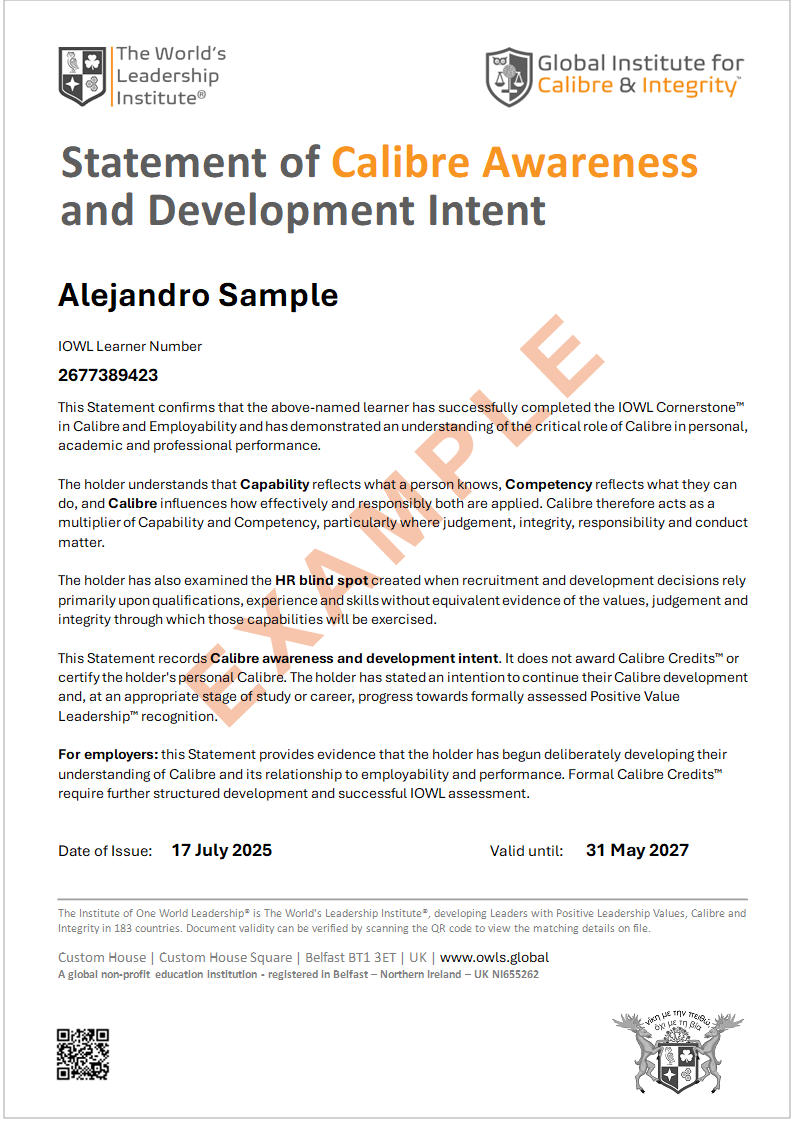
Statement of Calibre Awareness and Development Intent™
Linked to CAD001 Cornerstone.
This records completion of the introductory Cornerstone learning, understanding of why Calibre matters to employability and performance, and the learner's intention to continue Calibre development. It records awareness and development intent, with Calibre Credits™ and professionally assessed recognition becoming available through eligible deeper pathways.
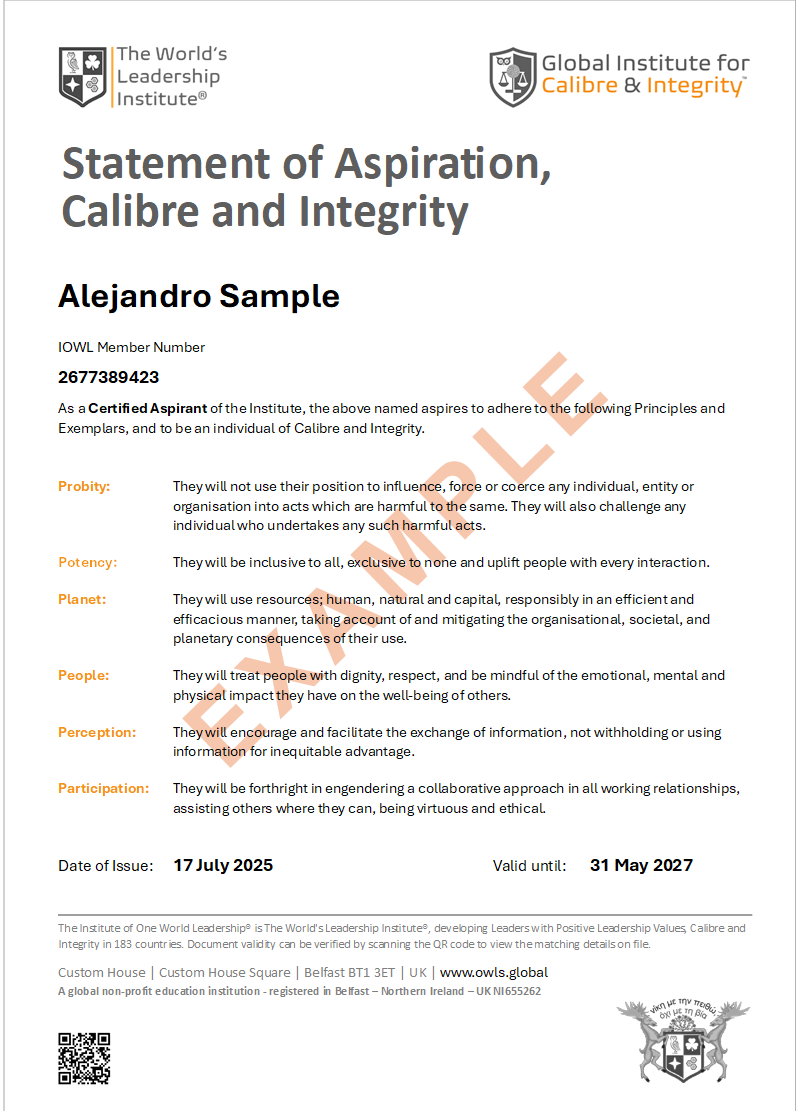
Statement of Aspiration, Calibre and Integrity
Normally linked to BPC100 Basal.
This records the learner's aspiration to engage with the principles and exemplars of Positive Value Leadership. It is appropriate for learners beginning their IOWL journey and helps frame early awareness of calibre, conduct and integrity.
Assessed professional pathways
Foundation, Keystone and Capstone learners who successfully meet the required learning, tutorial and assessment requirements receive stronger professional recognition records. These are the awards most directly linked to employability and graduate outcome narratives.


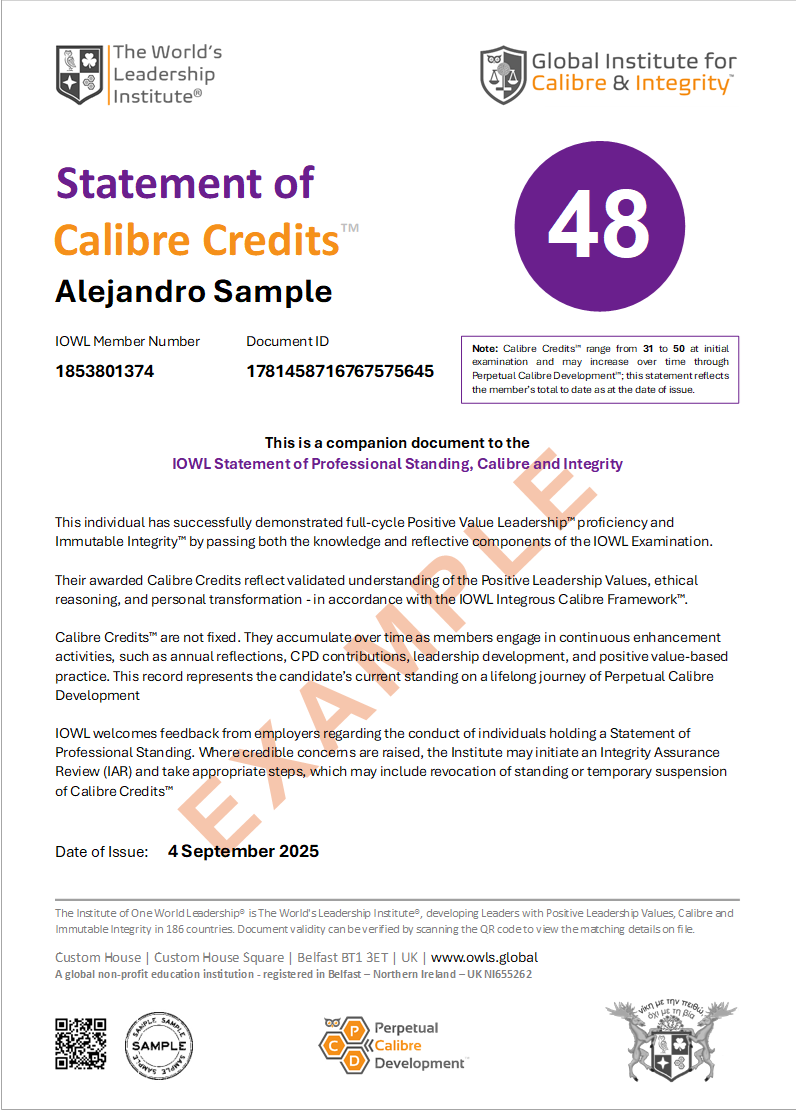
For graduate employability, these records help students move from assertion to evidence.
- They support graduate outcome conversations by evidencing calibre alongside academic achievement.
- They give employers a clearer signal of judgement, integrity and values-led agency.
- They help students explain how they respond to responsibility, influence, ambiguity and ethical pressure.
- They give universities a stronger way to describe student success beyond completion, grades and technical skills.
A university relationship that can grow with evidence
IOWL delivers Positive Value Leadership™, assessment and recognition centrally from Belfast and online. University partners do not need to become delivery centres.
Access and Opportunity first. Embed where valuable. Integrate where evidence supports it.
Access and Opportunity
IOWL and the university make lifelong Aspirant Access and the included STM010 Touchstone - Calibre Awareness light-touch, first-touch Stand Up step available to the agreed student population. Communications are planned jointly, students are onboarded through the Partner Portal, and activation is supported by both IOWL and the university.
No fee for whole-population access; Touchstone currently includedEmbed
Once whole-population Aspirant Access is established, the university can choose to fund defined student cohorts on selected IOWL development pathways. IOWL continues to deliver the learning, assessment and recognition centrally.
Rate agreed by paid embedded cohort sizeIntegrate
Where embedded delivery demonstrates value, IOWL can become part of wider student success, employability, leadership development, graduate attributes, alumni and lifelong-development provision. Wider adoption follows experience and evidence.
Wider institutional adoption follows evidenceHow do we get started?
For student or learner access, the university first establishes an approved institutional relationship with IOWL. The organisation and authorised representative are confirmed, the first Partner Administrator is activated, and the student-access purpose is approved before student population data is uploaded.
The communications journey uses seven Communication Stages. Stages 1–3 are university-owned pre-launch awareness, Stages 4–6 are direct IOWL activation communications, and Stage 7 is university-owned reinforcement after launch.
Once the relationship is ready, the objective is simple: students should understand what IOWL is, why Calibre matters, what lifelong Aspirant Access gives them, that Touchstone gives them an immediate Stand Up achievement after activation, and why they should activate now before IOWL sends the personal account-ready invitation.
IOWL confirms the university relationship and Partner Administrator. The university and IOWL then plan the rollout before student data is uploaded. Communication Stages 1–3 are university-owned awareness communications using channels such as student email, newsletters, LMS, student portal, careers, faculties, induction activity, posters and social channels.
The university accepts the applicable Aspirant Access terms and securely uploads the agreed student population through the Partner Portal. IOWL validates the data, returns exceptions for correction, identifies existing IOWL accounts without duplicating them, and prepares new people as Pre-Aspirants for controlled release.
After approval and release, IOWL owns Communication Stages 4–6: the Tuesday account-ready activation email and planned reminders. The university can monitor rollout and activation through the Partner Portal and provides Communication Stage 7 reinforcement through its own channels. The personal activation link remains separate from the contextual Welcome / FAQs information used in campaign communications.
Whole-population Aspirant Access is provided to the university at no fee, STM010 Touchstone is currently included with Aspirant Access, and later paid pathways remain a separate institutional choice. Student access is a controlled IOWL institutional route. The same university can separately establish workforce access for its own employees and staff through the organisation registration route.
What the university can see after launch
The Partner Portal is no longer only an upload and activation tool. It provides an operational and longitudinal view of the authorised university population while preserving the learner's direct IOWL relationship and private material.
Rollout and reconciliation
Uploaded, approved and correction-needed records; existing IOWL accounts; new Pre-Aspirants; Communication Stages 4–6 rollout; activation and outstanding activation. Existing accounts are reconciled rather than duplicated and their existing IOWL origin is not overwritten.
Progression and Calibre Gauge
Highest IOWL level attained, Aspirant Journeys and the Calibre Gauge can show the verified distribution across Stratum, Touchstone, Cornerstone, Basal, Bedrock, Foundation, Keystone and Capstone. Pre-Aspirants are excluded from the 100% attainment distribution.
Evidence & Sentiment
Where reportable data is available, aggregated evidence and sentiment can be shown subject to IOWL confidentiality and minimum-response rules. Free-text learner responses and private reflective material are not exposed through the Partner Portal.
What does each party need to do?
The operating model is deliberately low-burden for the university. IOWL manages the platform, learner invitation process and IOWL learning architecture; the university provides the institutional reach and student-population access that make whole-population opportunity possible.
The university provides
- a named institutional lead who becomes, or nominates, the first authorised Partner Administrator;
- completion of the institutional approval and applicable student-access terms;
- ownership of Communication Stages 1–3 pre-launch awareness and Communication Stage 7 post-launch reinforcement through appropriate university channels;
- lawful, accurate and complete data for the agreed student population;
- correction of records identified through IOWL validation and reconciliation;
- use of Partner Portal rollout and activation information to focus communications appropriately.
IOWL provides
- organisation/relationship review, Partner Portal provisioning and Partner Administrator activation;
- communications planning support, contextual Welcome guidance and agreed campaign materials;
- the university Partner Portal, population onboarding, validation and reconciliation workflow;
- controlled approval/release plus Communication Stage 4 Tuesday account-ready invitations and Communication Stages 5 and 6 planned direct reminders;
- rollout, activation, progression, Calibre Gauge and eligible aggregate evidence visibility for the university;
- My World and lifelong Aspirant Stratum access after activation;
- included STM010 Touchstone - Calibre Awareness - the light-touch, first-touch Stand Up learning step and Knowledge Check;
- all IOWL learning, assessment, recognition and learner administration.
A clear activation boundary
Before activation, the individual is represented within IOWL as a Pre-Aspirant: a university-supplied person held for the agreed institutional onboarding purpose. A Pre-Aspirant is not yet represented as an IOWL Aspirant.
When the student personally activates and accepts the applicable IOWL learner and privacy terms, the relationship changes. The individual becomes an IOWL Aspirant and lifelong Aspirant Stratum access begins.
The applicable institutional terms and data-protection arrangements define the parties' responsibilities for the pre-activation onboarding stage and the subsequent direct IOWL learner relationship.
Optional university-branded student experience
IOWL can separately scope customisation of parts of the student-facing experience to align with university branding, communications and implementation needs. This can include agreed university branding, contextual student-entry pages, co-branded campaign material or other approved configuration.
Customisation is separate from the no-cost whole-population Aspirant access model. Bespoke branding, configuration, development or implementation work is agreed separately and may carry an additional cost.
See the complete student pathway, recognition and pricing model
The full-width view shows the university onboarding entry point, every current IOWL development stage, the recognition attached to each level, normal learner fees for your detected country and when institutional embedded-cohort pricing becomes available.
See employer recognition guidanceHow Access, Embed and Integrate work operationally
The detailed phases below support the simpler three-stage model: whole-population opportunity first, embedded paid cohorts second, then wider integration where evidence supports it.
Institutional approval, Partner Administrator and mobilisation
IOWL confirms the university relationship and authorised representative, provisions the Partner Portal and establishes the first Partner Administrator before student population onboarding begins. The rollout plan is then agreed.
University role: nominate the institutional owner and identify the channels and internal teams that can reach students effectively. IOWL role: confirm the institutional route and prepare the Portal relationship.
Communication Stages 1–3 awareness, terms, upload and reconciliation
The university begins the planned Communication Stages 1–3 awareness campaign, accepts the applicable terms and securely uploads the agreed current-student data through the Partner Portal. IOWL validates the files, returns exceptions, reconciles existing IOWL accounts and prepares new people as Pre-Aspirants.
University role: provide lawful, accurate and complete records and resolve validation exceptions. IOWL role: protect against duplicate accounts and preserve existing IOWL account provenance.
Approval, release and activation campaign
Once the population is approved for release, IOWL sends Communication Stage 4 on the planned Tuesday and follows with Communication Stages 5 and 6 reminders where required. The university monitors rollout and activation through the Partner Portal and provides Communication Stage 7 reinforcement through its own channels. A person becomes an IOWL Aspirant only when they personally activate and accept the applicable learner terms.
Shared role: IOWL owns Communication Stages 4–6; the university owns Communication Stage 7 and can use Portal status to avoid unnecessary repeat communications to people who have already activated.
Stand Up, then voluntary progression and embedded paid cohort
Activated partner learners can take STM010 Touchstone - Calibre Awareness without entering a paid pathway. They then remain free to choose their own route. Cornerstone is the natural Stand Out next step, while My World may recommend a higher substantive pathway where the learner profile supports it. The university may also choose to embed a specific paid IOWL pathway with a defined cohort.
University role: support informed choice, communicate the appropriate pathway and funding route, and sustain participation.
Integration and continuing development
Where embedded delivery demonstrates value, the university may integrate IOWL pathways into student success, employability, leadership development, alumni engagement, employer partnerships or lifelong-learning provision.
IOWL role: retain assessment, standards, recognition, certification and Calibre Credit authority.
Evidence, research and policy contribution
Where appropriate, the relationship can help build anonymised and aggregated evidence about student agency, Calibre development, engagement, employability confidence and graduate-outcome relevance.
Shared value: evidence can contribute to research, institutional learning and wider policy discussion, subject to data protection, consent and any agreed research or reporting schedule.
What makes implementation work
Successful whole-population access depends on more than uploading a file. It requires visible institutional ownership, coordinated student communications, reliable data, clear activation guidance and sustained follow-through.
Partnership routes
Access and Opportunity
IOWL and the university build awareness across the agreed student population. The university uploads student data through the Partner Portal, IOWL validates it and sends account-ready invitations, and each student chooses whether to activate. Lifelong Aspirant Stratum access begins on activation.
University cost: no charge for whole-population Aspirant access.
Embed
After full student-population onboarding, the university may embed Cornerstone, Basal, Bedrock, Foundation, Keystone or Capstone with a defined paid cohort.
Institutional rate: available by individual agreement once whole-population Aspirant onboarding is complete; the rate depends on paid embedded cohort size.
Integrate
Where embedded delivery demonstrates value, IOWL can be integrated across student success, employability, leadership development, graduate attributes, employer engagement, alumni or lifelong learning.
Best for: universities ready to move from a successful cohort model towards wider institutional architecture.
Customise
IOWL can separately scope a more university-branded student experience, contextual communications, co-branded entry pages or other agreed implementation work.
Commercial position: customisation is optional, separately scoped and may carry an additional cost.
Connect the university proposition to the wider Calibre architecture
Three reference pages help universities understand the language, intellectual case and lifelong development architecture behind the partnership proposition.
Use a common language for Capability, Competency and Calibre
The canonical IOWL definitions help universities explain the three dimensions consistently to students, staff, employers, researchers and institutional stakeholders.
Read the employability position paper
Beyond Graduate Outcomes examines established employability theory, the closest published antecedents, the OECD Learning Compass, the IOWL development chronology and the specific Capability-Competency-Calibre proposition.
From university access to lifelong Calibre development
Aspirant Access and assessed PVL pathways are not the end point. Perpetual Calibre Development™ provides the continuing architecture as graduates move through employment, changing contexts and increasing responsibility.
Frequently asked questions
These questions help universities understand the practical partnership model, the Employability Progression™, and the deeper developmental, assessment and evidence architecture that sits behind it.
Practical questions about what students receive, how recognition works and how a university can implement the model.
For student/learner access, the university first establishes the approved institutional relationship with IOWL. The organisation and authorised representative are confirmed, the first Partner Administrator is activated, and the student-access purpose is approved before the student population is uploaded.
The university and IOWL then plan the rollout. The university owns Communication Stages 1–3 awareness communications; the university uploads the agreed population; IOWL validates and reconciles the data, including existing IOWL accounts; approved new people become Pre-Aspirants; and IOWL owns Communication Stages 4–6 direct activation communications. The university then provides Communication Stage 7 reinforcement while using Partner Portal status to focus attention on people who remain outstanding.
Institution approved > Partner Administrator activated > Communication Stages 1–3 > Upload > Validate & reconcile > Approve & release > Communication Stage 4 — Tuesday activation > Communication Stage 5 > Communication Stage 6 > Activate > Communication Stage 7 reinforcement.
Whole-population Aspirant Access is provided to the university at no fee, STM010 Touchstone is currently included with Aspirant Access, and later paid pathways remain a separate institutional choice.
The relationship can be led by employability or careers, student success, academic leadership, external engagement, a Pro-Vice-Chancellor or Vice-President portfolio, or another nominated institutional lead.
What matters is that one person has clear ownership and can coordinate the colleagues needed for implementation, particularly student communications, data, careers or employability, relevant faculties and senior sponsorship. The Partner Portal then gives that lead a practical view of onboarding and activation.
IOWL gives students an additional evidence layer beyond academic achievement and skills. It helps them demonstrate calibre, judgement, values-led agency and responsible conduct, which are increasingly important when employers compare graduates with similar qualifications.
Calibre Credits™ are a distinct IOWL recognition within Perpetual Calibre Development™: a lifelong record of assessed growth in calibre, integrity, values-led judgement and Positive Value Leadership™. The first Calibre Credits™ awarded through Foundation, Keystone or Capstone become the foundation of a continuing professional record that can grow through further learning, reflection, leadership practice and contribution over time.
Academic credits usually recognise progress through a formal curriculum. CPD often records continuing skills or professional updates. Calibre Credits™ are different: they evidence the development of the person beneath the qualification - how the learner exercises judgement, responsibility, integrity and values-led agency when their capability and competency are put into practice.
IOWL is developing a wider recognition roadmap for Calibre Credits™, Positive Value Leadership™ and the IOWL Statement of Professional Standing. University partnerships can help generate evidence, insight and practice-based learning that informs IOWL’s wider conversations with employers, professional bodies, policy organisations, OECD forums, government consultations and academic networks.
The roadmap is an advocacy and recognition-development framework. Formal endorsements and recognition relationships are represented where they have been agreed and are appropriate for public presentation.
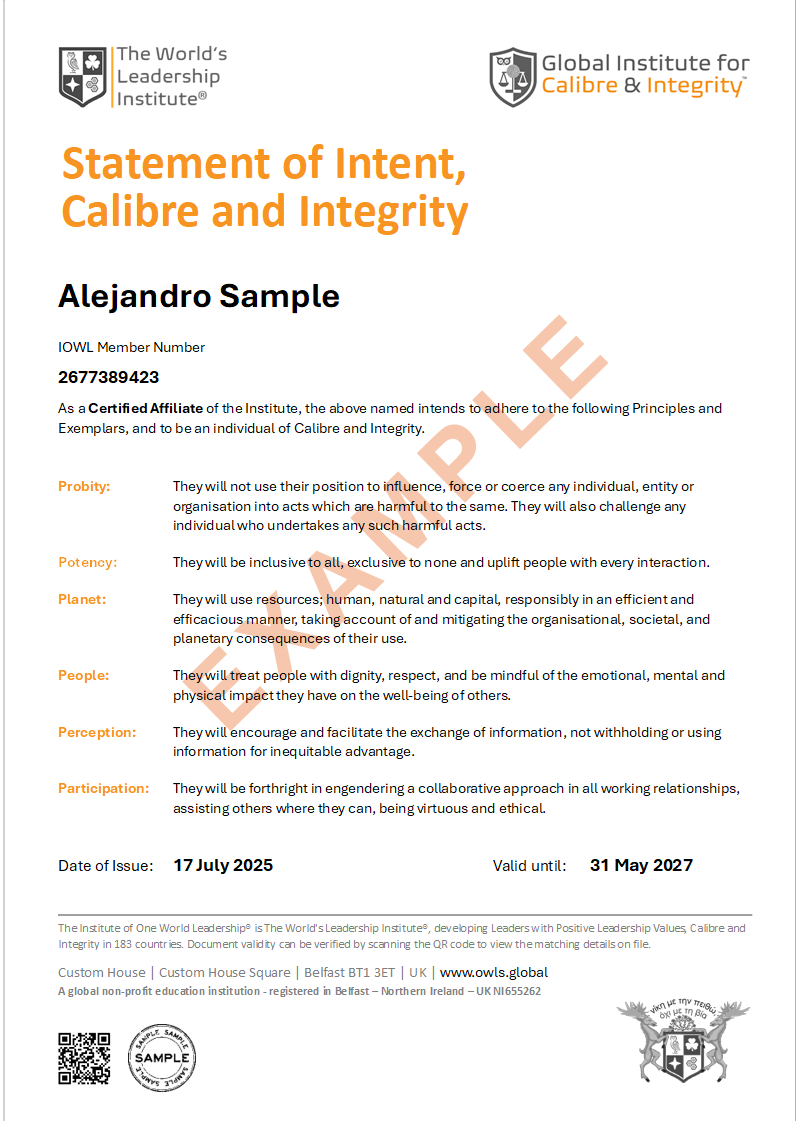
Touchstone, Cornerstone, Basal and Bedrock provide progressive early recognition: Statement of Calibre Awareness, Statement of Calibre Awareness and Development Intent™, Statement of Aspiration and Statement of Intent. Calibre Credits™ begin with the assessed professional pathways: Foundation, Keystone and Capstone.
The university uses its IOWL Partner Portal to manage institutional onboarding: agreed student data is uploaded, validated and imported, then IOWL sends the student-facing Aspirant account-ready invitations.
IOWL provides My World, delivers Positive Value Leadership™ centrally from Belfast and online, and retains responsibility for learning, assessment, standards and recognition. The university strengthens reach through internal communications and student mobilisation.
Students can use IOWL records in employability portfolios, interviews, mentoring conversations, alumni development and professional profiles. The value is strongest when students explain the judgement, conduct and values-led leadership behaviours behind the record.
The full agreed current-student population is included. The university securely uploads the required student data through its IOWL Partner Portal. IOWL validates the data and, once accepted, creates a Pre-Aspirant record supplied through the university for each student and sends the personal account-ready invitation.
Before activation, that record is an institutional access record and the individual is not yet an IOWL Aspirant. When the student personally activates and accepts the applicable IOWL learner terms, the IOWL Aspirant relationship begins and lifelong Aspirant Stratum access becomes active. Eligible alumni may also be included through a separately agreed extension.
Activation is the point at which the individual personally accepts the applicable IOWL learner and privacy terms and becomes an IOWL Aspirant. Aspirant Stratum access then becomes active and remains available to the learner for life, including after graduation or departure from the university.
Activation establishes the lifelong Aspirant relationship. Progression beyond Aspirant remains a separate learner choice, with university-funded or embedded pathways available where agreed.
The university encourages every learner to activate their account and become familiar with IOWL and the opportunity. Activated learners can take STM010 Touchstone - Calibre Awareness as the included Stand Up step, then choose whether and how far to progress through Cornerstone, Basal, Bedrock, Foundation, Keystone or Capstone.
For a university student, the institution has already supplied the access data through the Partner Portal and IOWL has validated it before issuing a personal account-ready invitation. The student then activates that institutional access record and becomes an IOWL Aspirant.
A direct visitor who is not part of a university access arrangement creates an Aspirant account independently. Both routes lead into lifelong Aspirant Stratum access. Invited university students simply activate the record already prepared for them.
Student opportunity comes first. The university uploads the full agreed current-student population, IOWL validates the records and issues the Aspirant account-ready invitations.
Once that whole-population opportunity is established, the university can discuss institutional pricing for defined paid embedded cohorts. Individual activation remains the student's choice and can be encouraged through coordinated university and IOWL communications.
Under the standard model, IOWL provides whole-population My World learner accounts and lifelong Aspirant Stratum access at no fee to the university. The university can communicate this as a student benefit arising from its relationship with IOWL.
After the full agreed current-student population has been uploaded, validated and issued with the opportunity to activate Aspirant Access. Institutional rates are then discussed separately for a defined paid embedded cohort and depend principally on the size of that cohort.
The institutional eligibility condition relates to the full agreed current-student population. Alumni can also be offered My World and Aspirant access through a separately agreed extension, while embedded-cohort rate discussions can proceed once the current-student onboarding condition is met.
Yes. Access and opportunity are central to the model. Students can explore My World and, where eligible, choose their own development route. An embedded university cohort is an additional institutional option, not the only way a student can progress.
Yes, where agreed. IOWL can separately scope university branding, contextual student-entry pages, co-branded campaign materials and other approved configuration or development work.
Bespoke branding and implementation work is separately scoped and costed according to the university's requirements.
IOWL is communicating directly to HR professionals and employers that they should look for Statements of Professional Standing and Calibre Credits™, use assessed Calibre evidence as a preferred additional criterion in hiring and promotion where appropriate, and provide a PVL development route for suitable new appointees who can strengthen their evidence through further Calibre development.
How a university makes Aspirant Access official, self-manages student onboarding and works with IOWL to maximise activation.
IOWL's standard model is deliberately simple. An authorised university representative accepts the versioned IOWL University Aspirant Access Terms through the Partner Portal. That acceptance creates the institutional access arrangement for the Aspirant stage and the included STM010 Touchstone Stand Up opportunity, and is recorded for audit purposes.
A separate institutional order or agreement is used later if the university chooses to fund an embedded Cornerstone, Basal, Bedrock, Foundation, Keystone or Capstone cohort, commission customisation or enter a wider strategic collaboration.
The university creates the authorised population in its Partner Portal and uploads one or more source files. IOWL validates the data, returns exceptions for correction, reconciles people who already hold IOWL accounts and prepares genuinely new people as Pre-Aspirants. Existing IOWL accounts are linked rather than duplicated and their existing IOWL origin is not overwritten.
After IOWL approval and controlled release, the Portal shows rollout, activation and reconciliation status so the university can follow the agreed launch without manually maintaining a separate activation list.
The Partner Portal shows the operational information needed to manage the institutional rollout, including uploaded and approved records, correction-needed records, existing IOWL accounts, new Pre-Aspirants, Communication Stages 4–6 rollout status, activation and outstanding activation. Where appropriate it can also show Highest IOWL Level Attained, Aspirant Journeys, the Calibre Gauge and eligible aggregated Evidence & Sentiment.
The attainment distribution counts true Aspirants and above only and excludes Pre-Aspirants. Aggregate sentiment is subject to IOWL confidentiality and reportability rules; private reflections and free-text learner responses are not exposed to the university through the Partner Portal.
Yes. The launch is deliberately shared. The university owns Communication Stages 1–3 so students hear about IOWL before the direct invitation. IOWL then owns Communication Stage 4, the Tuesday account-ready activation email, followed by Communication Stages 5 and 6 planned reminders where required. The university provides Communication Stage 7 reinforcement through its own channels.
Partner communications can use the IOWL contextual Welcome / FAQs link to explain the opportunity safely before activation. That contextual link is not an authentication credential; each student's personal activation link remains separate. Portal status lets the university focus communications on people who still need to act.
The individual becomes an IOWL Aspirant when they personally activate. Before that point, the university-supplied person is a Pre-Aspirant held for the authorised onboarding purpose established through the institutional terms.
Activation is the transition point: the learner accepts the applicable IOWL learner and privacy terms, Aspirant Stratum access becomes active and the individual's direct IOWL learner relationship begins.
They remain Pre-Aspirants rather than active IOWL Aspirants. The applicable University Aspirant Access Terms and data-protection arrangements define the authorised onboarding purpose, correction process and retention/deletion/anonymisation treatment for people who never activate. Pre-Aspirants are not included in the Portal's 100% Highest IOWL Level attainment distribution.
The standard terms govern Aspirant Access, onboarding and the included STM010 Touchstone Stand Up opportunity. Touchstone is currently included with Aspirant Access for activated learners. Later paid pathways, embedded cohorts and wider institutional activity are selected and agreed separately.
Paid embedded pathways, bespoke development, co-branding or wider institutional integration are agreed separately if the university later chooses to proceed.
IOWL believes the initial institutional decision should be straightforward and transparent. The summary below allows a university to understand the intended responsibilities before entering the Partner Portal. The final binding version will be the versioned terms presented to the authorised university representative for acceptance.
Why the pathway begins with universal, no-fee Aspirant Access, how the progression is intended to strengthen graduate differentiation, and how individual development can contribute to wider university and societal impact.
The progression describes the increasing employability relevance of Calibre development and evidence alongside a learner's Capability and Competency. Aspirant Access is the activation point. STM010 Touchstone is Stand Up: a deliberately light-touch, first-touch Calibre experience that culminates in demonstrated introductory awareness and makes the learner Noticeable. CAD001 Cornerstone is Stand Out: deliberate Calibre awareness and development intent make the learner increasingly Preferable. Basal and Bedrock are Step Out: increasingly Valuable routes through aspiration and intent. Foundation, Keystone and Capstone are the professionally assessed Jump Out pathways intended to help the individual become increasingly Indispensable to employers and organisations.
These terms describe progressive differentiation and employer value as Calibre development deepens through the IOWL pathway.
IOWL removes the financial barrier at the point where a learner first encounters the idea of Calibre, enabling students to understand its relevance to employability, competitiveness, judgement and future contribution from the outset.
Aspirant Access therefore gives every learner in the agreed university population an opportunity to explore My World. Touchstone then gives activated learners a no-fee, one-hour, light-touch first route to demonstrate introductory understanding through a Knowledge Check before they decide whether to progress into deeper paid or professionally assessed development.
Understanding the potential value of Calibre should come before being asked to pay for deeper development.
Because the potential value is broader than producing a small cohort of formally recognised learners. Even at Aspirant level, a student may begin to reconsider a decision, interaction, responsibility or consequence through a Calibre lens. That first shift in awareness or judgement can itself create value, with deeper assessed recognition available through later pathways.
Across a university population, many small individual shifts can accumulate through relationships, teams, communities, workplaces and civic life. The intended pathway is therefore:
individual awareness > interpersonal influence > university community > workplace and civic participation > wider societal progress.
This is a developmental proposition rather than a claim that universal access by itself guarantees measurable societal impact. Wider effects require continuing evidence and evaluation.
Aspirant Access is the account and opportunity entry point. Activation opens My World and creates the platform from which Touchstone awareness recognition and later Calibre Credits™ progression can follow.
Touchstone is the first learning recognition and the learner's first recognised touchpoint with Calibre. After completing the required learning and Knowledge Check, the learner can receive a Statement of Calibre Awareness confirming introductory understanding and establishing the Stand Up awareness step before deeper development.
Societal change does not only occur through major interventions. An individual who pauses before reacting, considers the consequences of a decision, becomes more conscious of another person's perspective, challenges an assumption or recognises the importance of integrity may make only a small behavioural adjustment.
Repeated across many situations and many people, incremental changes can influence families, teams, organisations and communities. IOWL therefore distinguishes between formal recognition of development and the potentially wider value of early Calibre awareness.
Explore why IOWL sees values-governed judgement as consequential.
Because IOWL deliberately distinguishes early awareness, aspiration and developmental intent from professionally assessed evidence of Calibre development.
Touchstone records demonstrated introductory awareness following a deliberately light-touch, first-touch encounter with Calibre. Cornerstone records awareness and development intent. Basal records aspiration. Bedrock establishes stronger structured intent and preparation. Calibre Credits™ begin only when the learner moves into the professionally assessed Foundation, Keystone or Capstone pathways and meets the applicable assessment requirements.
Because the context and consequences of judgement become more complex as a person's sphere of influence expands. Foundation principally develops Calibre in relation to self and personal agency. Keystone extends that development into organisations, relationships and influence. Capstone considers society, systems and wider consequence.
The progression therefore represents increasing contextual complexity and responsibility, not a claim that a person at one level is morally superior to another.
Explore the contextual progression within the Calibre development architecture.
It describes the strategic ambition to help graduates become people organisations increasingly trust, value, rely upon and select for greater responsibility.
Capability may help someone qualify for a role. Competency may help them perform it. Calibre can strengthen the judgement, integrity, responsibility and values-led agency through which both are exercised.
The progression treats Capability, Competency and Calibre as complementary dimensions. Qualifications and skills remain essential, while Calibre adds the human judgement governing how they are exercised.
A person may have strong values but still lack the knowledge or practical competence required for a role. Equally, strong knowledge and skills do not by themselves determine how those abilities will be exercised. IOWL therefore treats Capability, Competency and Calibre as complementary dimensions.
Explore the Capacity Conundrum™ and the three-dimension proposition.
Because doing so can blur a substantive difference. Knowledge, technologies, techniques and role-specific competencies can become outdated or be superseded. Integrity, responsibility, fairness, respect and consequence-aware judgement are not rendered obsolete by a new technology or working method.
Calibre remains developmental and contextual. Its expression can strengthen and recalibrate over time while the underlying human requirement persists as context changes. Perpetual Calibre Development™ therefore focuses on continuing reflection and recalibration as capability, circumstances and responsibility change.
IOWL takes a developmental view of employability, treating it as something that can strengthen across a person's career.
IOWL defines employability as the evolving capacity of an individual to obtain opportunity, perform effectively, remain relevant, progress and contribute increasing value within work.
Employment is one outcome within a wider employability journey. Employability can continue to strengthen through opportunity, performance, relevance, progression and increasing contribution across changing labour-market conditions.
The IOWL Employability Progression™ asks a further question: as Capability and Competency become increasingly comparable between candidates, what can make one individual more likely to be noticed, preferred, valued and ultimately relied upon?
Noticeable describes the beginning of differentiation beyond qualifications and skills. Preferable describes a stronger reason to prefer the individual among otherwise comparable candidates. Valuable reflects increasing contribution beyond the technical requirements of a role. Indispensable describes the ambition that the individual becomes increasingly trusted, relied upon and selected for greater responsibility.
These are progressive employer-value positions. Longitudinal and independent research can continue to deepen understanding of the relationship between assessed Calibre, recruitment, progression, retention and organisational performance.
Read the full IOWL Employability Position Paper.
Review IOWL's Emerging Evidence and research position.
A university could examine account activation and participation, progression between stages, learner reflection and developmental evidence, assessment and Calibre Credit outcomes, student perceptions of employability and judgement, employer response to the evidence and, over time, graduate and longitudinal indicators.
IOWL builds from immediate developmental evidence into longer-term longitudinal evaluation of employment, organisational and societal effects, with independent evaluation adding further strength.
For academic leaders, employability teams, quality specialists and institutional partners who want to understand the intellectual case, the transformation mechanism and the current evidence position.
IOWL's Capacity Conundrum™ starts from a different question. Universities, employers and governments can continue to increase knowledge, skills, technology and institutional capacity, while Calibre adds the human dimension governing how that capability is exercised. Judgement, integrity, incentives, relationships and values can influence whether capacity is converted into dependable performance or into poor, misdirected or harmful outcomes.
IOWL therefore treats Calibre as a distinct human dimension alongside Capability and Competency. The proposition complements skills development through a distinct Calibre layer.
Explore the Capacity Conundrum™ and the wider intellectual case.
Governance, professional ethics, compliance and regulation provide essential organisational and external expectations and controls. Calibre strengthens the individual judgement through which those systems are interpreted and applied, especially when circumstances are ambiguous.
The IOWL contention is that stronger internal values-governed judgement can complement those upper-strata systems. The opportunity is to strengthen governance and the human judgement operating beneath it together.
See the Axiological Pyramid and the inside-out / outside-in argument.
PVL is designed as a developmental process rather than a list of desirable words. Learners move through increasing awareness of self and others, interaction, influence, ingestion, impact and internalisation, supported by reflection, reinforcement and rigour. The purpose is to move from recognising a Positive Value to examining how it affects judgement, behaviour, relationships, influence and consequence.
This is why IOWL distinguishes information acquisition from Reflective Transformation. The architecture therefore moves from knowing the language of values into demonstrated developmental engagement with them.
Explore how Positive Values are developed, evidenced and translated into Calibre recognition.
IOWL does not determine demonstrated Calibre from a single test score, self-report or polished final response. Demonstrated Calibre is determined from a governed body of evidence generated within the relevant pathway.
The public architecture combines structured learning engagement, knowledge assessment, applied and reflective activity, and controlled reflective assessment. Depending on the pathway, the evidence can demonstrate not only what a candidate knows, but how consistently they understand, interpret, apply and reflect upon Positive Value Leadership in context, including the development and coherence of judgement over time.
Calibre outcomes therefore depend upon converging evidence of knowledge, application, judgement, reflection, authenticity and demonstrated engagement, together with satisfaction of the applicable participation, assessment and integrity requirements.
The detailed calibration, weighting, moderation, evidence interpretation, conversion, decision and integrity methodology — including the methods by which IOWL evaluates relationships between different forms of evidence — is protected IOWL know-how and is not publicly disclosed. This protects the validity of the methodology against replication, coaching to the mechanism or gaming.
Universities and independent researchers can scrutinise IOWL’s published standards, assessment architecture, learner requirements, resulting evidence, outcomes and recognition claims, and can independently evaluate the underlying propositions without access to the protected mechanics used to produce an individual Calibre determination.
Start with the public Basis of Calibre: what it is and how demonstrated Calibre is determined.
Then examine the transformation and recognition architecture in more detail.
IOWL publishes the information learners, universities and researchers need to understand what is being developed, the public evidence architecture, the candidate-facing learning and assessment stages, the governance of recognition and what a Calibre Credits™ outcome represents.
This includes the forms of evidence that may contribute to a Calibre determination, such as structured engagement, knowledge assessment, applied and reflective activity, controlled reflective assessment and the requirements governing participation, authenticity and assessment integrity.
IOWL does not publish the proprietary mechanics by which those different forms of evidence are calibrated, weighted, related, interpreted, moderated, converted or used within decision and integrity processes. This includes protected methods for evaluating patterns, consistency and progression across the learning and assessment journey, together with anti-gaming and replication-resistant controls.
This creates a deliberate public/protected boundary: the meaning, standards, evidence architecture and governance of the award are transparent, while the detailed methodology used to produce an individual Calibre determination remains protected IOWL know-how.
See the public Basis of Calibre and its explicit public/protected boundary.
Explore the detailed transformation and recognition architecture.
IOWL deliberately separates different kinds of evidence. Its Emerging Evidence includes observed learner response and developmental patterns from PVL, while external research provides contextual convergence around subjects such as integrity, trust, governance, productivity, skills utilisation and human behaviour. Research propositions and scenario modelling are identified separately and are not presented as demonstrated causal outcomes.
The evidence base is described as emerging because longitudinal causation, wider labour-market effects and macroeconomic impact require further independent study. IOWL's intention is to make those distinctions visible rather than collapse them into a single impact claim.
Review IOWL's Emerging Evidence and evidence classifications.
IOWL examines Calibre as a conditioning and potentially multiplying dimension of human performance. External work, including OECD research, provides useful convergence around the role of integrity, governance, trust and decision quality in converting skills, resources and institutional capacity into productive outcomes.
IOWL's further question is whether deliberate development of values-governed judgement can improve the reliability of that conversion. Independent empirical evaluation can continue to strengthen and refine that proposition.
See the distinction between external convergence, observed evidence and research propositions.
A university can of course teach ethics, values, leadership, employability and professional practice. IOWL's proposition is different: it provides an end-to-end specialist architecture dedicated specifically to Calibre, connecting the Capability-Competency-Calibre distinction, a common Positive Values baseline, contextual progression, Reflective Transformation, assessment, protected calibration, recognition governance, Calibre Credits™, professional standing, Perpetual Calibre Development™, the Employability Progression™, and the application of Calibre to dependable and sustained performance.
The partnership model therefore allows a university to retain its core strengths in academic Capability and Competency while adding an external specialist Calibre-development and evidence layer without having to reproduce that complete architecture, its governance, its recognition system and its continuing performance framework internally.
Review the Basis of Calibre and the public answer to “Why IOWL?”
Explore the transformation and recognition architecture. Explore the Capacity Conundrum.
Start with student opportunity. Build from there.
Give the full student population access first: activate My World, make the STM010 Touchstone Stand Up opportunity visible to every activated learner, then let them Stand Out through Cornerstone, Step Out through Basal or Bedrock where appropriate, and Jump Out through professionally assessed PVL pathways when they are ready.
Help students move beyond being merely employable towards becoming increasingly valuable - and potentially indispensable - to the organisations they join.
See Positive Value Leadership pathwaysStudent/learner access is an IOWL-controlled institutional route. Workforce access for university employees/staff can be registered separately through the organisation registration process.
Email: preferred@owls.global